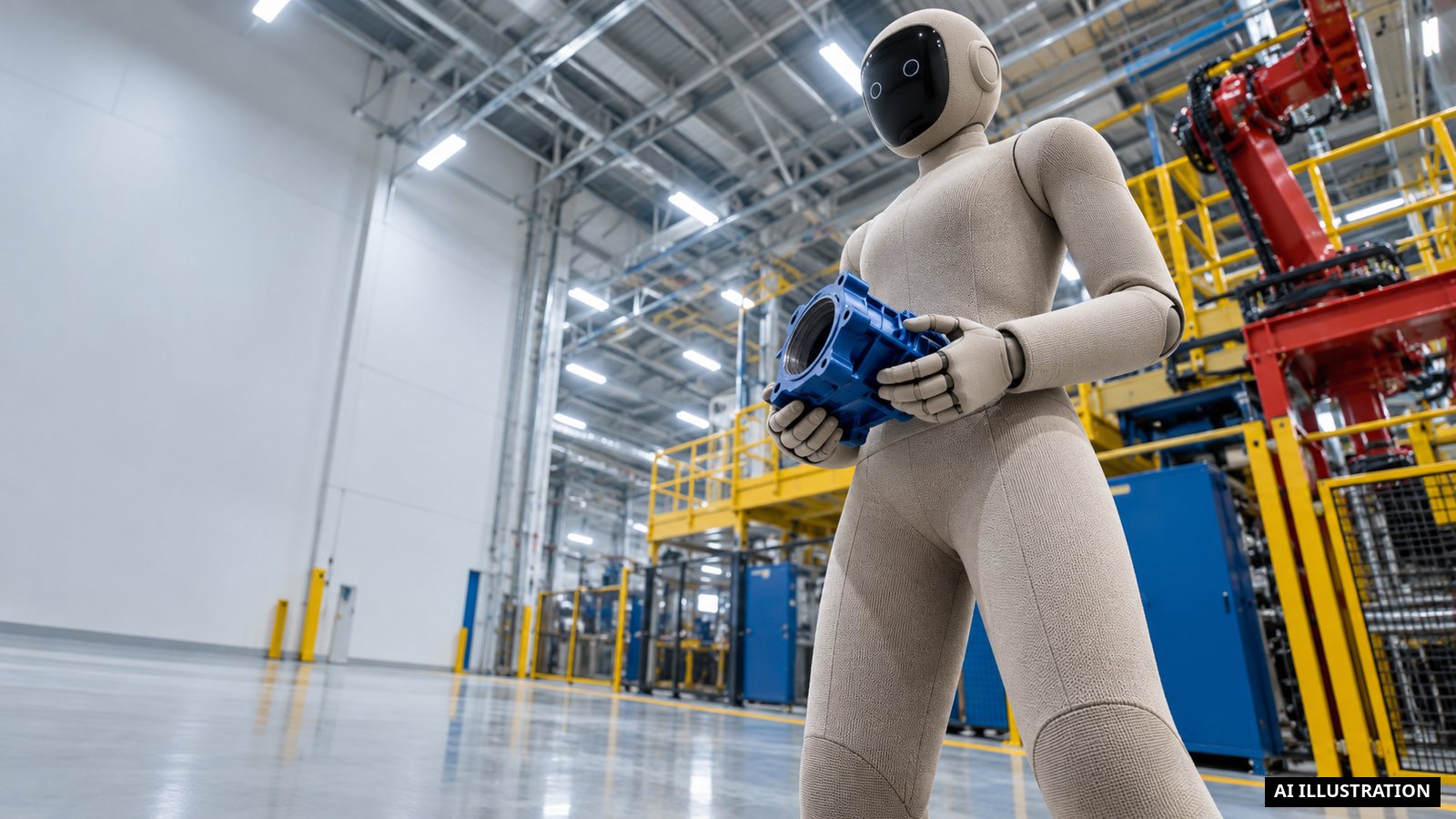
We had introduced it to you as the great promise of the home of the future: NEO, the humanoid robot (a machine with a human shape, two arms, two legs) from the young Norwegian company 1X. A companion designed to fold laundry, tidy the kitchen and open the door for you, all for a listed price of 20,000 dollars, which is roughly the same as a new small car, according to the specialist website TechCrunch.
However, NEO is not going to your living room. It is heading to the factory.
From the living room to the warehouse: a discreet change of direction
On 11 December 2025, 1X announced a partnership with EQT, an investment fund, to deploy its NEO robots in the industrial world: manufacturing workshops, warehouses, logistics. Still according to TechCrunch, the agreement provides for these robots to be put at the service of companies owned by EQT, and this between 2026 and 2030.
The press release speaks of a strategic partnership. The vocabulary is flattering, but it masks an awkward detail: the robot designed for the home is going off to work on the assembly line. Yet these are two opposite worlds. A domestic robot must be gentle, safe, and capable of coexisting with children and a cat. A factory robot must carry loads and keep up the pace. Designing one is not the same as designing the other.
When a company moves its flagship product from one market to another, it is not always a conquest. It can be an admission: the original market, in this case the home, is not yet ready to buy. And that is the whole point of this announcement.
Up to 10,000 robots… but for which customers?
The agreement covers, according to TechCrunch, the deployment of up to 10,000 NEO robots. The figure is impressive. But a question deserves to be asked: to whom will these robots be sold?
The answer is revealing. EQT has more than 300 companies in its portfolio, meaning companies in which the fund is an owner or shareholder. And it is precisely these companies that are eligible to receive 1X’s robots. In other words, the fund that finances 1X is itself providing the first customers.
To put it simply: it is a bit like the bank that lends you money to open a bakery also being the owner of the 300 cafés in the neighbourhood, and asking them to order their croissants from you. You have customers, yes. But did they come to you because your product is the best, or because they were recommended to do so from above?
Real demand, or manufactured demand?
This is the heart of the matter. An order book backed by companies from the same fund is not quite the same thing as a market scrambling to buy. In the first case, demand is partly organised by the investor. In the second, it comes from the ground up.
This does not mean that the robots will not work, nor that the partnership is a bad deal. Having a full-scale testing ground, with 300 potential companies, is a real asset for a young company. But it changes the reading of the announcement. It is not the market is demanding our robots. It is rather our main financial backer is opening the doors of its own companies to us.
And the promise of the 20,000-dollar robot?
The big question for the public remains: what happens to the affordable domestic robot, the one we were supposed to find in our kitchens? For now, the signal sent is not reassuring for impatient individuals. When you redirect your flagship product towards industry, it is often because the home, itself, is not paying yet.
The available facts, derived from a single secondary source, invite caution: they describe an industrial agreement, not the official abandonment of the home project. 1X has not said it is giving up on the living room. But the timeline speaks: before NEO folds your laundry, it will first stack boxes in warehouses that, for many, belong to the same circle of investors.
The promise of the 20,000-dollar domestic companion is not dead. It is, for the moment, on hold. And perhaps that is the real message of the announcement.