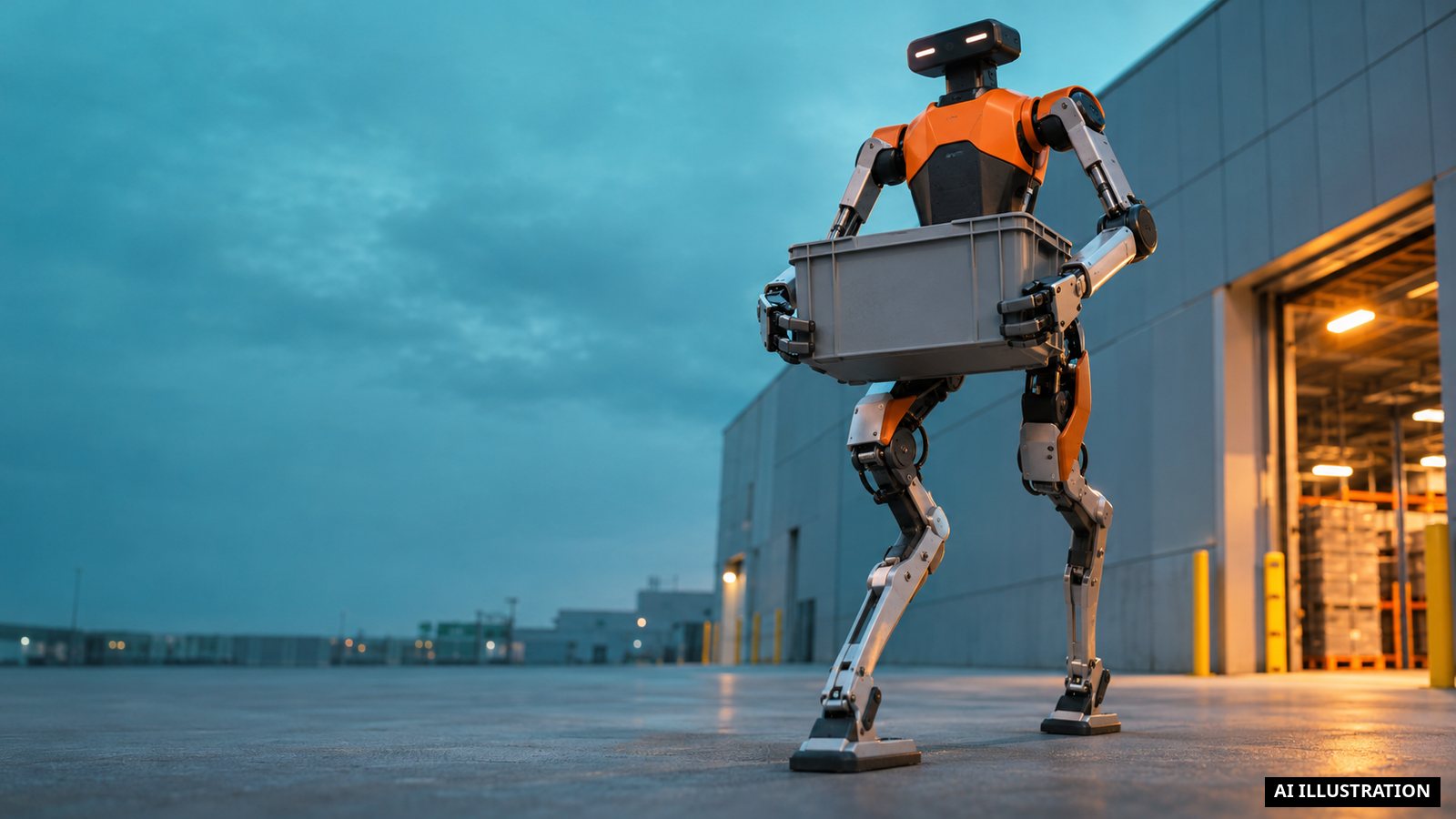
No demo. No fragile prototype. Just work, raw and continuous. While you are reading these lines, this biped may have already handled more boxes than you have carried in your entire life. This is where everything shifts. Not in a sterile laboratory, but in the concrete reality of global logistics.
Agility Robotics has just crossed a historic milestone. It has become the first American company specialising in humanoid robots to be listed on the Nasdaq under the ticker AGLT (AI Insider, BigGo Finance, Business Insider, agilityrobotics.com). It is now the only publicly traded American company exclusively focused on humanoid robotics with active commercial deployments (AI Insider, BigGo Finance, Business Insider, agilityrobotics.com). It is no longer a start-up looking for investors. It is an industrial machine looking for customers. And it has found its market.
The Nasdaq validates the end of the exception
The merger with Churchill Capital Corp XI, a SPAC led by Michael Klein, valued Agility’s existing equity at approximately 2.5 billion dollars (AI Insider, BigGo Finance, Business Insider, agilityrobotics.com). The deal is expected to raise approximately 465 million dollars in gross capital before fees, including 100 million dollars already received (BigGo Finance, Business Insider). These figures are not anecdotal. They signal that venture capital has stopped betting on the future to finance the present. Agility’s investors include Amazon, Foxconn, Nvidia, SoftBank and the Silicon Valley venture capital firm DCVC (Business Insider). These are the industry giants holding the reins. They are not funding an idea. They are funding a production chain.
Look at the financial figures. According to its filings, Agility generated 1.8 million dollars in revenue and reported a net loss of 138.1 million dollars for the year 2025 (BigGo Finance, Business Insider). The loss is massive. But it is the price of the race. Agility’s valuation of 2.5 billion dollars is far lower than that of its private rivals, notably Figure AI at approximately 39 billion dollars, Apptronik at approximately 5.5 billion dollars and Neura Robotics at approximately 7 billion dollars (BigGo Finance, Business Insider). The market is in a frenzy. The stock exchange is not there to say it is profitable. It is there to say it is real. That the robots walk. That the factories run. That human labour is no longer a variable for adjustment, but a variable of risk.
65,000 hours: the biped is already at client sites
Agility’s humanoid robot Digit is commercially deployed in nine client facilities, including those of Amazon, Toyota, GXO Logistics, Schaeffler and Toyota Motor Manufacturing Canada (AI Insider, BigGo Finance, Business Insider, agilityrobotics.com). Nine sites. Not one. Nine. This is where fiction meets reality. GXO recently agreed to add the Digit robot to two other facilities in the United States, with operations scheduled to begin in early 2027 (AI Insider, agilityrobotics.com). And Agility has signed an agreement with agricultural equipment manufacturer AGCO to test the Digit robot at its Hesston plant in Kansas, starting in 2027 (AI Insider, agilityrobotics.com). This is no longer an experiment. It is an expansion. The robot is entering agriculture, the automotive sector, and logistics. It is entering the sectors that drive the economy.
Imagine your factory. Your warehouse. Your production line. Now, imagine that tomorrow morning, a biped is standing in front of you. It does not replace you yet. It assists you. But it does not sleep. It does not take breaks. It does not complain about the hardship. The 65,000 hours already logged are just the beginning. The question is no longer "does it work?". The question is "does it work well enough that you are no longer indispensable?".
1,000 robots ordered: does the 2027 countdown begin for you?
Agility has secured over 300 million dollars in multi-year orders for 1,000 robots of its new-generation Digit 5, from a single client who will pay to use the robots over a three-year period, with deliveries targeted for 2027 (AI Insider, BigGo Finance, Business Insider, agilityrobotics.com). One thousand robots. One single client. Three years. This is a large-scale order. It is a proof of trust. This client knows the robot will deliver on its promises. And if an industry giant can afford to order one thousand units, what happens to SMEs? To medium-sized enterprises? To you?
Agility operates an American manufacturing plant called RoboFab, designed to produce up to 10,000 robots per year (AI Insider, BigGo Finance, Business Insider, agilityrobotics.com). The company aims for a production of 800 units in 2027, 7,000 in 2030 and up to 25,000 in 2035 (AI Insider, BigGo Finance, Business Insider, agilityrobotics.com). The figures are clear. Production will explode. Costs will fall. Availability will increase. In three years, buying a humanoid robot will no longer be a luxury. It will be a standard investment. Like a computer. Like a printer. Like a forklift.
And if your business does not adapt? What if your competitor equips its lines with Digit 5? It will produce more. It will cost less. It will deliver faster. You will be behind. Not by a few months. By a few years. The Nasdaq has just given the green light. Investors have voted. The market has spoken. Humanoid robotics is no longer an option. It is a necessity. Your job, your profession, your routine: everything is changing. Not tomorrow. Today. The robots are already here. They are working. And you?
Agility Robotics is based in Salem, Oregon, and has offices in Pittsburgh, Pennsylvania, and Fremont, California (agilityrobotics.com). These are not just addresses. They are nerve centres. This is where the future of work is being drawn. And this future has a face. It has two legs. It has arms. It has a name: Digit. And it is already at Amazon. At Toyota. Perhaps at your place, even before you see it.