
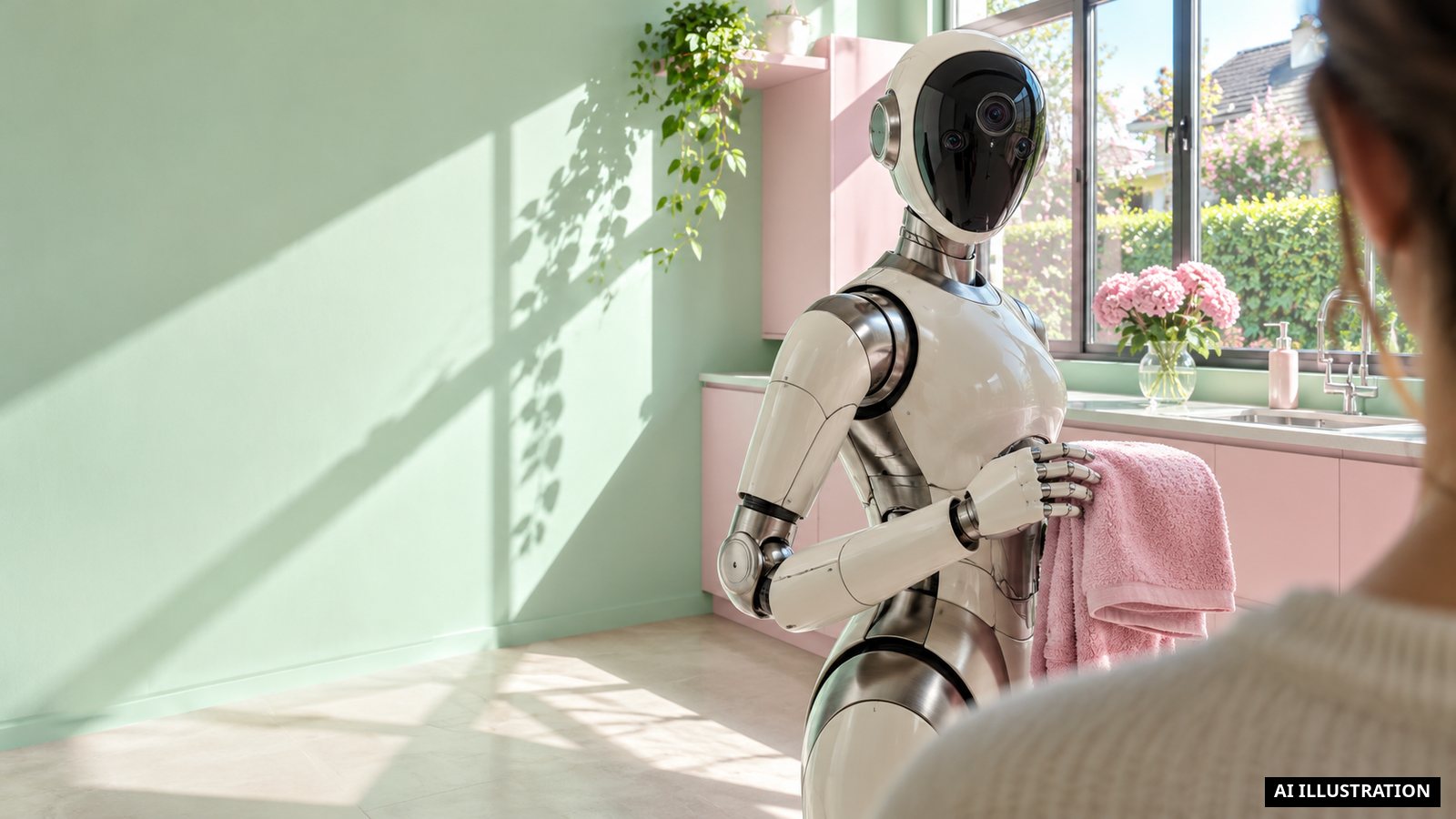
In a house in North Carolina, the silence is never total. A small white robot glides across the floor, its sensors sweeping through the empty rooms. Emily Lugo Velez is absent, but she knows that something is watching. Her robot Astro monitors her pets and appliances, a digital eye placed on her daily life (CNBC). This is not science fiction. It is already the case for a few thousand lucky individuals. But this is only the beginning. Amazon has just formed a new team dedicated to domestic robots, with a clear objective: to create a ‘new robotic product for the world’ (CNBC, Unite.AI).
The dream: an ally that learns to know you
Imagine a companion that does not merely follow rigid instructions. It enters your home, it observes, it adapts. This is the implicit promise of this new division, named Personal Robotics Group. To achieve this, Amazon acquired Fauna Robotics, a New York-based start-up, in March 2026 (CNBC, Unite.AI). The objective? To integrate their humanoid robot Sprout into this new entity. Sprout is not a simple toy. Measuring 1.07 metres and weighing 22.7 kilograms, it was launched in January 2026 for researchers and developers (Unite.AI). It is equipped with time-of-flight sensors to avoid obstacles and a modular software architecture (Unite.AI). But it is not just a matter of muscles or code. It is a matter of presence.
The job listings published by Amazon reveal an obsession: trust. A listing for a principal UX designer at Fauna describes the design of interaction with the robot, including ‘trust, personality and integration into daily life’ (Unite.AI). They are not just looking for a tool. They are looking for a being that knows when to intervene, when to remain silent, how to move without frightening. Ken Washington, former vice-president of consumer robotics at Amazon, revealed that Jeff Bezos was impressed by Astro’s ability to map undefined spaces, but disappointed by its lack of features (CNBC). The new robot must fill this void. It must navigate changing domestic environments and operate autonomously around family members, according to a recently deleted job listing (Unite.AI). Around you. Not beside you. Around.
The fear: the connected swarm and intimate data
What makes this project dizzying is the infrastructure behind the scenes. A robot in your kitchen is already intrusive. A swarm of robots is another dimension. Amazon’s job listings for Fauna include the development of cloud services to connect robot swarms (Unite.AI). Imagine your home as a node in a vast network. Every movement, every sensor activated, every obstacle avoided by Sprout or its successor generates data. High-frequency telemetry data, processed by dedicated teams (Unite.AI). Who reads it? Who analyses it? And above all, what do they do with the 3D map of your living room, the frequency at which you open the fridge, the exact time you go to bed?
Astro, the precursor, was already a mobile security monitor. Launched in 2021 for 1,450 dollars, it could navigate alone and recognise faces (CNBC, Unite.AI). But it never went beyond the beta stage and was shipped to only a few thousand customers by invitation (CNBC, Unite.AI). Amazon even launched a professional version in 2023, which was discontinued less than a year later (Unite.AI). The public was not ready, or the product was not. Today, with the acquisition of Fauna and the arrival of Sprout, the ambition is greater. CEO Andy Jassy characterised AI and robotics as major inflection points in his 2025 letter to shareholders, published on 9 April 2026 (CNBC, Unite.AI). More than one million robots already operate in Amazon’s order fulfilment centres (CNBC, Unite.AI). The logistics are there. The technology is there. All that is missing is your home.
The doubt: are we ready for the intrusion?
Brad Glasser, a spokesperson for Amazon, states that the company is optimistic about a future where personal robots help people in a meaningful way (CNBC, Unite.AI). It is a nice phrase. But ‘help’ is a vague word. Help to tidy up? Help to monitor? Help to control? Emily Lugo Velez uses her Astro to monitor her pets and appliances when she is absent (CNBC). This is a precise, limited use. The new robot promises more. It promises to adapt to your family, to your habits. But adaptation requires observation. And observation requires sensors. Cameras, lidars, microphones. In your bedroom? In your bathroom?
The boundary between assistance and surveillance is thin. A robot that ‘operates autonomously around family members’ (Unite.AI) must know where you are at all times. It must know if you are in danger, if you are ill, if you are alone. This is the dream of absolute security. But it is also the loss of total privacy. The on-site technical support, mentioned in the job listings, suggests that these machines will not be perfect. They will break down. They will need to be repaired. Who will have access to your data during this maintenance? The cloud is the heart of this system. The robot swarms are connected. The telemetry data is processed at high frequency. Everything converges towards a control centre. And you are at the centre of the target.
Amazon continues to support Astro customers and has acquired Fauna as part of its commitment to tackling the challenges of personal robotics (CNBC, Unite.AI). The challenge is technical, yes. But it is also psychological. Accepting a mechanical being in the most intimate space of our lives. Accepting that it watches us. Accepting that it learns from us. The robot of tomorrow will not just be a device. It will be a witness. And a witness is a memory. A memory that no longer belongs entirely to you.
Perhaps tomorrow, you will receive an invitation. Not for a beta test. For your life. The robot will arrive in a box. It will connect to the Wi-Fi. It will scan the walls. It will learn your comings and goings. And one evening, when you are tired, it will bring you what you want, at the moment you need it. This is the dream. But at night, when you sleep, it will remain there. Watching. Listening. Recording. And what if it were in your home, tonight?