
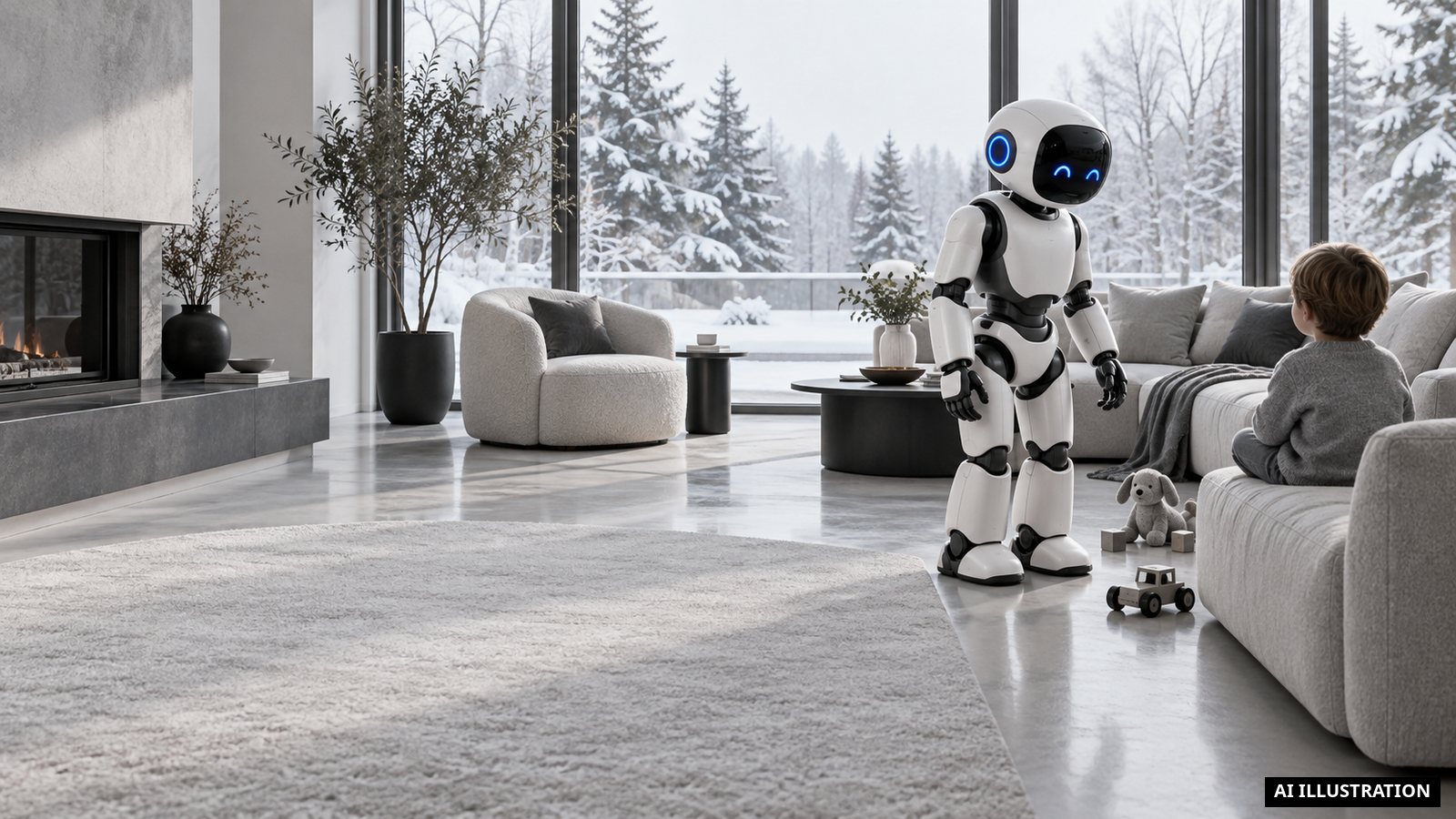
The silence of the living room is broken by a fluid movement. A humanoid silhouette glides between the sofa and the coffee table. It does not trip. It does not bump into your children’s feet. It recognises the toy that has fallen to the floor, avoids it with surgical precision, and then turns towards you. This is Mobo. Chery’s first domestic robot, via its subsidiary AiMOGA Robotics, has just opened its global pre-orders (InsideEVs Italia, KrASIA, La Razón, M3 Motorcube, autonocion.com, il Giornale).
For now, it does not put away your plates. It does not vacuum. But it does something else, perhaps more important: it is there. It observes. It learns. And it looks at you.
$99 to reserve, $399 in credit, no final price: will the family robot make itself at home in your living room?
The entry price is surprisingly low. $99. That is the amount to pay today to reserve Mobo (il Giornale). It is not a purchase, it is a promise. In return, Chery credits you with $399 towards the final purchase at the time of launch (il Giornale). A marketing gesture? Perhaps. But it is also a strong signal: the company wants you to be there, in the circle of early adopters.
The trap is the absence of clear figures. There is no announced final price. No precise delivery date. Not even an official sales plan for Spain, although Chery plans to open reservations in certain markets (La Razón, autonocion.com, il Giornale). You are reserving in the fog. You are betting on trust. And if you are wrong? Does the $399 credit remain secured? The rules of the game are not yet fully written. But the excitement is real. More than 10,000 potential customers worldwide have already expressed their interest since Mobo’s launch at the World Robot Conference in August 2026 (InsideEVs Italia, KrASIA, M3 Motorcube).
Chery does not intend to simply sell boxes. The company plans to launch a network of 300 experience centres worldwide (InsideEVs Italia, KrASIA, M3 Motorcube). Places where you can touch, see and interact. Before bringing it home. It is a risky gamble. A robot in an experience centre is a demonstration. A robot in your living room is intimacy. The boundary is fine. And it is erasing itself a little more every day.
It dances, it talks, it remembers: but it does not yet do the housework
What can Mobo do? It has 22 degrees of freedom in its body (InsideEVs Italia, KrASIA, La Razón, M3 Motorcube, autonocion.com, il Giornale). What does that mean concretely? It is the ability to move. To articulate its arms, legs and head. These 22 points of movement allow it to perform complex gestures, maintain stability and execute dance routines (InsideEVs Italia, KrASIA, La Razón, M3 Motorcube, autonocion.com, il Giornale). Imagine it dancing in your kitchen, arms raised, rhythm in its legs. It is fluid. It is human. It is unsettling.
Under the hood, it is the MoAgent system that drives everything (InsideEVs Italia, KrASIA, La Razón, M3 Motorcube, autonocion.com). This artificial intelligence interprets complex instructions. It plans tasks. It combines spatial perception, natural language understanding, visual recognition and long-term memory (InsideEVs Italia, KrASIA, La Razón, M3 Motorcube, autonocion.com). Concretely, Mobo can recognise objects. It dodges moving obstacles. It memorises the preferences and habits of family members (La Razón, autonocion.com, il Giornale).
It knows that your son likes dinosaurs. It knows that your mother prefers the light to be dimmed in the evening. It adapts. It offers assistance and companionship on a daily basis (La Razón, autonocion.com, il Giornale). This is where the dream becomes real. Mobo is designed for three main scenarios: companionship and assistance for the elderly, interaction with children and support for the needs of the whole family (M3 Motorcube).
Think about your parents. They are ageing. They are afraid of loneliness. Mobo can be there. It can talk. It can reassure them. Think about your children. They need stimulation. Mobo can play. It can dance. It can be an inexhaustible playmate. But beware: it is not a nanny. It is not a nurse. It is a robot. And it has its limits.
The greatest of these limits: it does not do the housework. Mobo is not yet ready to perform domestic chores (il Giornale). No dishes. No dust. No laundry. It is an observer, a companion, a dancer. Not a servant. This is a crucial distinction. The service robot, the one that cleans, is not there. Not yet. Mobo, for its part, is the first step towards the family humanoid. A step that dances, that talks, that remembers. But that leaves the kitchen dirty.
More than 10,000 potential customers, 300 experience centres: Chery’s gamble for the home
Chery is no stranger. It is a Chinese automotive group. But here, it is not selling cars. It is selling intimacy. By launching Mobo, it is entering the most sacred of spaces: the home.
Its 300 experience centres will not be shops. They are laboratories of life. You will see Mobo in action there. You will test its capabilities. You will measure your comfort in the face of this mechanical presence. It is a full-scale test.
And what if the robot knows you better than you know yourself? If its long-term memory (InsideEVs Italia, KrASIA, La Razón, M3 Motorcube, autonocion.com) records your slightest gestures, your preferences, your silences? It adapts its interactions (La Razón, autonocion.com, il Giornale). It becomes a mirror. A mirror that dances. A mirror that talks. And one day, perhaps, a mirror that cleans. But for now, it is content to look at you. And to wait for you.
The question is no longer “do I want a robot?”. The question is: “am I ready for it to look at me?”