Stand 208 is empty. No banner, no demo, no researcher explaining a sensor. Just a number on a white wall, amidst the hubbub of the CoRL conference in Austin. This is where OpenAI was supposed to present its advances in autonomous robotics. But the stand is empty (Fortune). The autonomous robotics research team has just been disbanded. Its researchers have been reassigned to the main research team under the direction of Mark Chen, while the applied robotics and hardware teams have been integrated into Greg Brockman’s Applied organisation (BigGo Finance, Fortune, The Decoder).
This silence is deafening. It says everything about a paradigm shift. For years, robotics lived in its own corner. Specialised engineers, dedicated algorithms, expensive sensors. Everything was done so that the robot could understand the physical world without external help. OpenAI has just said: ‘No.’ According to the company, its general models, including GPT-6 Astra, have demonstrated that they can directly control robots (BigGo Finance, Fortune, The Decoder). The need for specialised robotics models is fading. Robotics is becoming a downstream application of general intelligence.
The empty stand that said it all
Imagine your living room. A robot enters. It does not look at the world with the eyes of a specialist. It does not try to identify every object as an engineer would. It sees, it understands, it acts. Like you. Like me. That is what OpenAI wants. The robot is no longer an isolated machine. It is the physical interface of a general intelligence. And that intelligence is GPT-6.
In a Nvidia study, an agent powered by GPT-6 Astra achieved a success rate of 74.8% on a simulated manipulation benchmark, using a simulated DROID robot (BigGo Finance, Fortune, The Decoder). For comparison, the best specialised robotics models did not exceed 51.0%. The difference is stark. The general model wins. It wins because it has learned the world, not just the task. It knows what a cup is, not just how to grasp it. It knows what a kitchen is, not just how to avoid obstacles.
On the StationeryBench benchmark, GPT-6 Astra fully completed 7 tasks out of 100 (The Decoder). MolmoAct2, a dedicated robotics model from Ai2, completed none. Astra’s average progress score was 46, compared to 12 for MolmoAct2. The numbers speak for themselves. The generalist beats the specialist. And this is not an exception. It is a trend.
What if GPT-6 cleaned your kitchen?
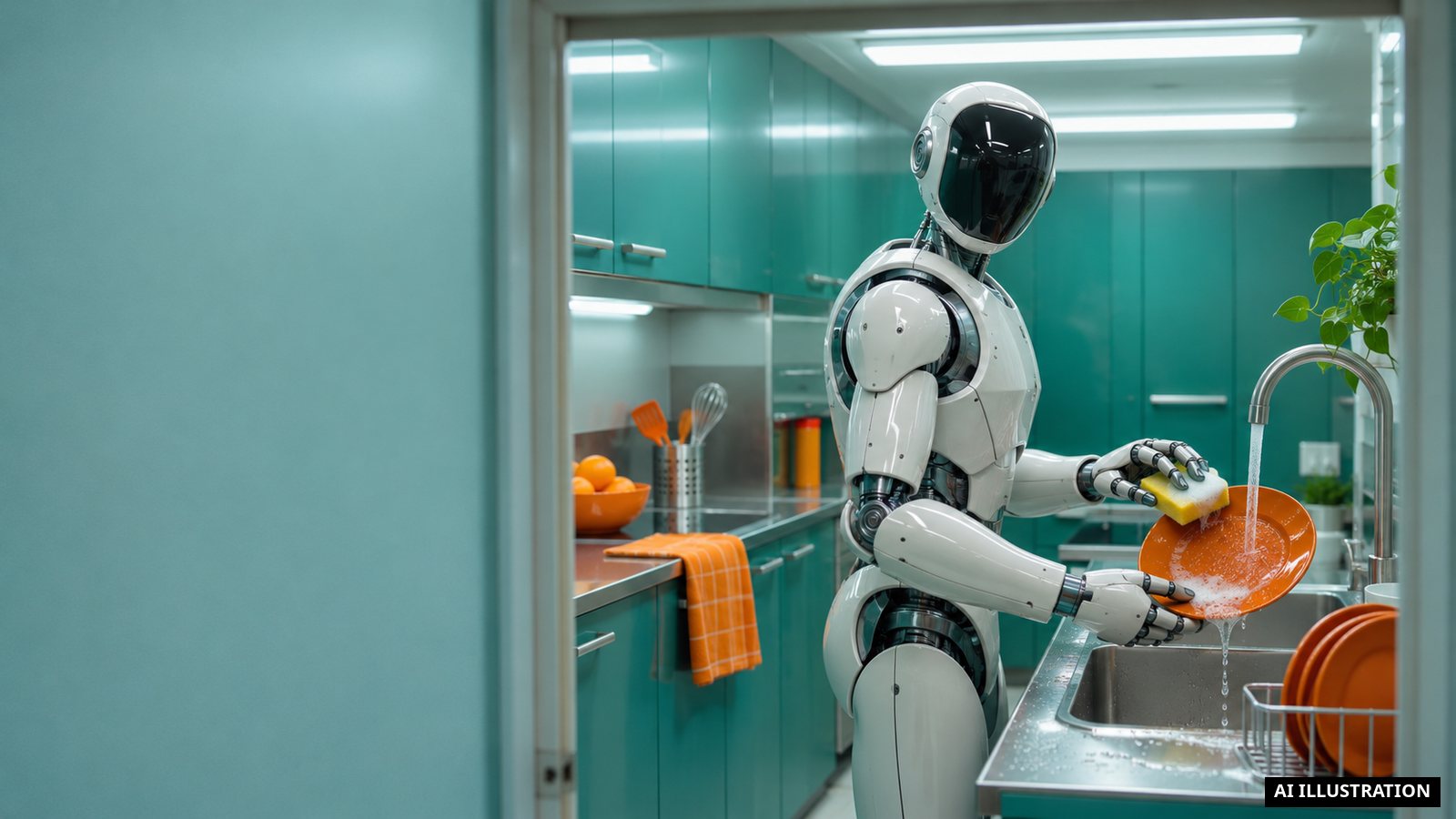
A test showed that GPT-6 Astra, executed on a humanoid robot, navigated and cleaned a kitchen (The Decoder). Not a laboratory kitchen. A kitchen. With its shocks, its blind spots, its objects lying around. The robot understood. It acted. It cleaned. Who gave the instructions? Not a programmer. Not a robotics engineer. A language model. The same one that helps you write a cover letter or plan your holidays.
What if your future robot did not know ‘cleaning’? What if it knew ‘doing’? The distinction is crucial. A specialised robot knows how to do a task. A general robot knows how to do what you ask it to. You tell it: ‘Put the plates in the dishwasher.’ It does it. You tell it: ‘Tidy up the children’s toys.’ It does it. You tell it: ‘Prepare dinner.’ It does it. Not because it has been programmed for each action. Because it understands the context. Because it has learned the world.
UBTech tested GPT-6 Astra and found that the combination with a dedicated model reduced token consumption by 83.6% and estimated API costs by 74.2% during the bowl stacking test (BigGo Finance). Companies are optimising. They are looking for the best of both worlds. But the direction is clear. The general model is the engine. The dedicated model is the optimiser. The brain is GPT-6.
Google DeepMind published the results of the Gemini Robotics 2.5 model on 10 November, achieving a success rate of 96% in parts sorting tests with the Apollo 2 humanoid robot in Mercedes-Benz factories in Germany and Hungary (BigGo Finance). Nvidia GR00T 2 achieved a success rate of 95% on 50 tasks after a 30-minute fine-tuning on an RTX 5090 card, compared to 40% in zero-shot (BigGo Finance). Anthropic’s Claude Fable 5.2 model, unveiled on 9 November, achieved an average success rate of 64.9% in RoboDojo Sim simulation tests, compared to 29.8% for GPT-6 Astra in the same framework (BigGo Finance). The race is on. But all players are converging on the same idea: general intelligence drives the robot.
The dream, the price, and the date
OpenAI’s CEO, Sam Altman, aims for a first public demonstration of his humanoid robot in 2027 (BigGo Finance, Fortune, The Decoder). Two years. That is tomorrow. And this robot will not need a team of specialists to function. It will need a subscription. A model. You.
Two months before the decision to disband, OpenAI was actively recruiting robotics talent with base salaries reaching up to 500,000 dollars (BigGo Finance). In January, OpenAI’s robotics data collection lab in San Francisco had approximately 100 workers using 3D-printed teleoperation controllers (BigGo Finance). These humans, these specialists, these engineers… They have been absorbed. Their role has changed. They no longer build the robot’s brain. They feed the general brain that drives the robot.
The direct control approach by GPT-6 Astra requires an average of 18.56 seconds per inference, with an estimated API cost of 36.40 dollars per successful task episode using the agent-based approach (BigGo Finance). For one task. For one cleaning. For one help. Is it expensive? Is it affordable? It is the price of intelligence. It is the price of freedom. It is the price of the end of specialisation.
What if your future robot no longer needed specialists? What if your relationship, your children, your parents, your work… everything became simpler? The robot does not judge. It does not get tired. It does not complain. It does. It does because it understands. It understands because it has learned the world. And that world is yours.
Stand 208 is empty. But the future is full. And it is coming. In 2027, perhaps. Or before. The robot that will clean your kitchen will not be an object. It will be an extension of you. An arm. A gaze. A hand. And it will not need specialists. It will need you. Your voice. Your trust. Your life.
And what if tomorrow, your robot asked you: ‘What do you want me to do?’