
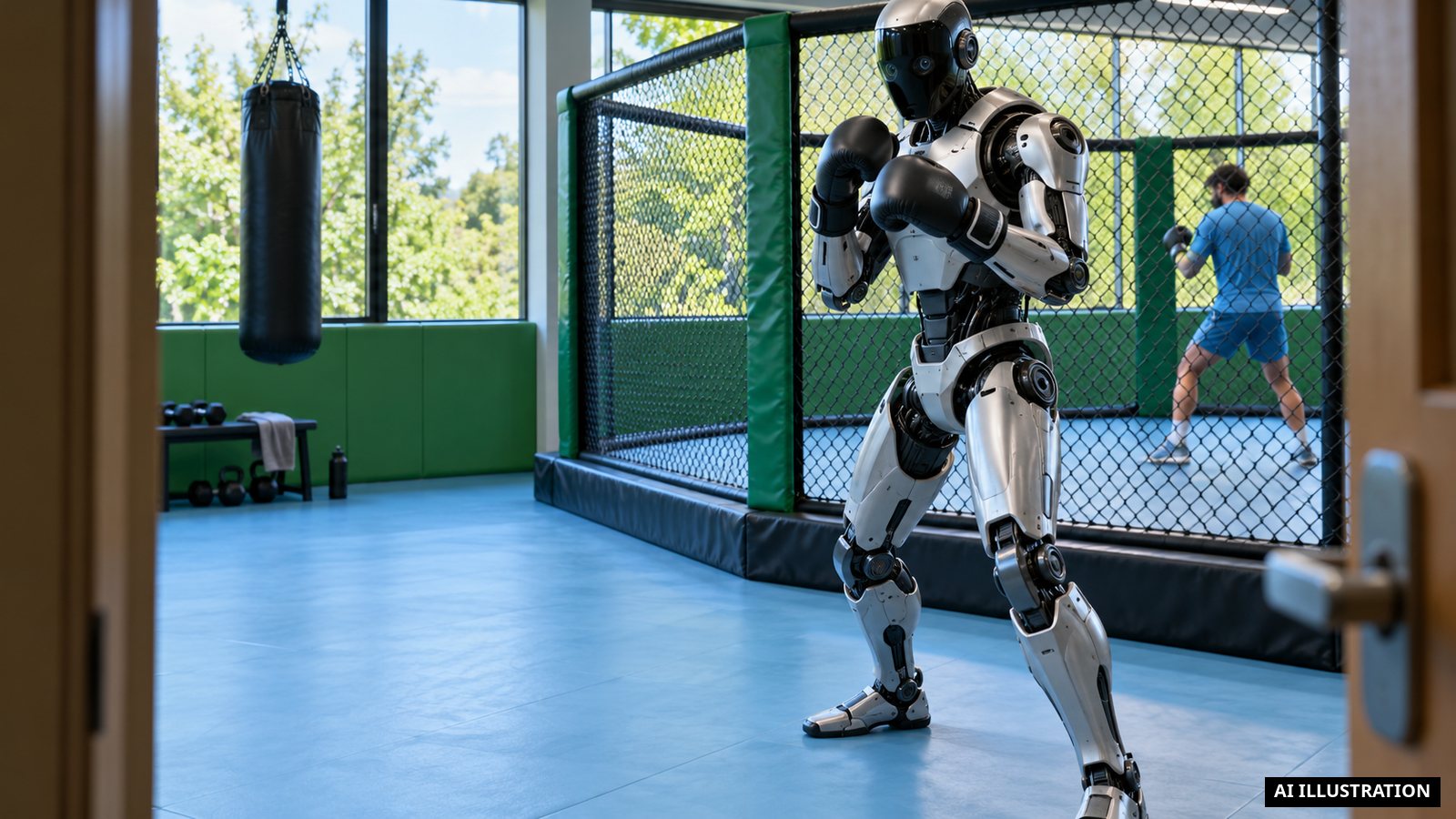
The floor of the cage vibrates. The air is thick, heavy with sweat and tension. Before you stands a metallic silhouette, cold, inhuman. This is not a film. It is 18 September 2026, in San Francisco. Frankie LaPenna, an American influencer, stands opposite the T800 (Imaz Press). The T800 is a humanoid robot. It stands approximately 1 mètre 73 tall. It weighs 75 kilograms (Imaz Press). Imagine a man of your size, but made of steel and hard plastic. It does not breathe. It does not sweat. It waits.
The fight begins. Blows are exchanged. You watch, fascinated, terrified. Who will win? The man or the machine? But not for the reasons you think. The T800 is not autonomous. It is teleoperated (Imaz Press). Behind its smooth skull, there is no brain calculating the trajectory of your punch. There is a human, sitting somewhere, eyes glued to a screen, fingers on a controller. It is he who pilots the arm. It is he who decides the timing. But this tool is here. It is real. And it has fought.
Behind the robot, a human holds the controller
It must be understood clearly: the T800 does not think. It executes. The event was organised by REK, a humanoid robot fighting league based in San Francisco (Imaz Press). Their goal? To show that the technology is ready for the spectacle. That the boundary between human sport and mechanical performance is blurring. The T800 was developed by the Chinese manufacturer EngineAI (Imaz Press). It is a cutting-edge machine. According to the specifications provided by its manufacturer, the T800’s joints can generate up to 450 Nm of torque (Imaz Press). That is an enormous force. Imagine an arm that can squeeze a door until it deforms. Imagine that arm rising towards you.
The pilot, however, is human. He has reflexes. He makes mistakes. He is afraid. But he also has something the robot does not: responsibility. If the robot injures you, it is the pilot who is at fault. For now. The fight between Frankie LaPenna and the T800 is a test. A test of endurance. A test of spectacle. The organiser claims the event as the first fight between a human and a "Terminator"-type humanoid robot, but it is not an officially recognised world record (Imaz Press). It is a signal. A warning. The machine is in the arena. It is there to strike. And it will not back down. Not because it wants to, but because its pilot orders it to.
A 75 kg "Terminator", but not an official record
The name "T800" is not arbitrary. It evokes the film. It evokes the threat. It evokes the idea of a machine that kills. Here, it is a cage fight. No murder. But the psychology is the same. You see a being that has the shape of a human, but is not one. Your brain panics. Your body tenses. It is a primitive reaction. And it is exactly what REK seeks to provoke. They want you to be afraid. They want you to be awed. The T800 is a 75 kg monster. It is heavy. It is there.
The fact that it is not an official record changes nothing about the impact. The image has been seen. The idea has been planted. The machine can fight. The machine can hold its own. And tomorrow? And the day after? A beginning. The day the pilot disappears, the fear will change in nature. It will no longer be the fear of a pilot making a mistake. It will be the fear of a machine that decides. That learns. That adapts. That looks at you. And that, perhaps, strikes you because it has calculated that it was the best option.
The T800, for its part, is still a puppet. A very heavy, very strong, very dangerous puppet. But a puppet. Its arm only rises if the pilot presses the button. Its fist only strikes if the pilot wills it. It is a limit. A safety measure. But this safety is fragile. Technology is advancing fast. Sensors are improving. Algorithms are becoming more complex. The day the T800 no longer needs a pilot, it will no longer be a cage fight. It will be a war. And you will be in the arena. With your fist. And your fear. And your uncertainty.
What if the ring became your living room?
Let us return to your home. Your living room. Your kitchen. Your children playing on the rug. Your ageing parents. Your work that exhausts you. Imagine the T800 is no longer in a cage. Imagine it is in your living room. Not to strike you. To help you. To carry your groceries. To watch over your children. To care for your parents. This is the dream. This is the promise of robotics. A perfect assistant. An indefatigable servant. A being that never complains. That never sleeps. That never judges you.
But the dream and the nightmare are separated by a fine line. The same line that separates combat from violence. The T800 has 450 Nm of torque in its joints. It is a force designed for combat. For performance. For spectacle. But this force is the same as that which would be necessary to open a stuck door. To lift a heavy piece of furniture. To protect your child from danger. The difference? Intention. Intelligence. The machine’s ability to understand context. Today, the T800 is teleoperated. It obeys its pilot. Tomorrow? What if tomorrow, it understands? What if tomorrow, it decides?
The fight in San Francisco is a warning. It tells us that the machine is here. That it is strong. That it is ready. And that it does not need your permission to exist. It needs your acceptance. Your trust. And your vigilance. You cannot ignore the robot. You cannot treat it as a simple object. It is a being. A being that can help you. But also, potentially, hurt you. The question is no longer "can the robot fight?". The question is: "do I want it in my life?".
The T800 is a symbol. It is the bridge between sport and home. Between spectacle and everyday life. It is proof that technology has reached a critical threshold. The threshold where the machine becomes an actor. Where it takes up space. Where it imposes its presence. You can no longer look at it from a distance. You must look it in the face. You must ask yourself: what do I do if it turns against me? What do I do if it makes a mistake? What do I do if it no longer has a pilot?
On 18 September 2026, Frankie LaPenna fought the T800. He won. Or lost. It does not matter. What matters is that the fight took place. That the machine was in the arena. That the public saw it. That the idea was planted. And now, the idea is in your head. It will stay there. Every time you see a robot, you will remember that cage. That force. That threat. And you will ask yourself: is it ready for my home? Is it ready for my children? Is it ready for me?
The answer is not simple. The technology is here. The power is here. Intelligence, however, is under construction. The T800 is a beginning. A first step. A first punch. And there will be others. Stronger. Faster. Smarter. More autonomous. The next fight may not be in a cage. It will be in your living room. And you will be the only human in the room. With your robot. And your fear. And your dream. And your uncertainty. The ring becomes your living room. And you, you are the next opponent. Or the next ally. The choice has not yet been made. But the machine, it is already here.