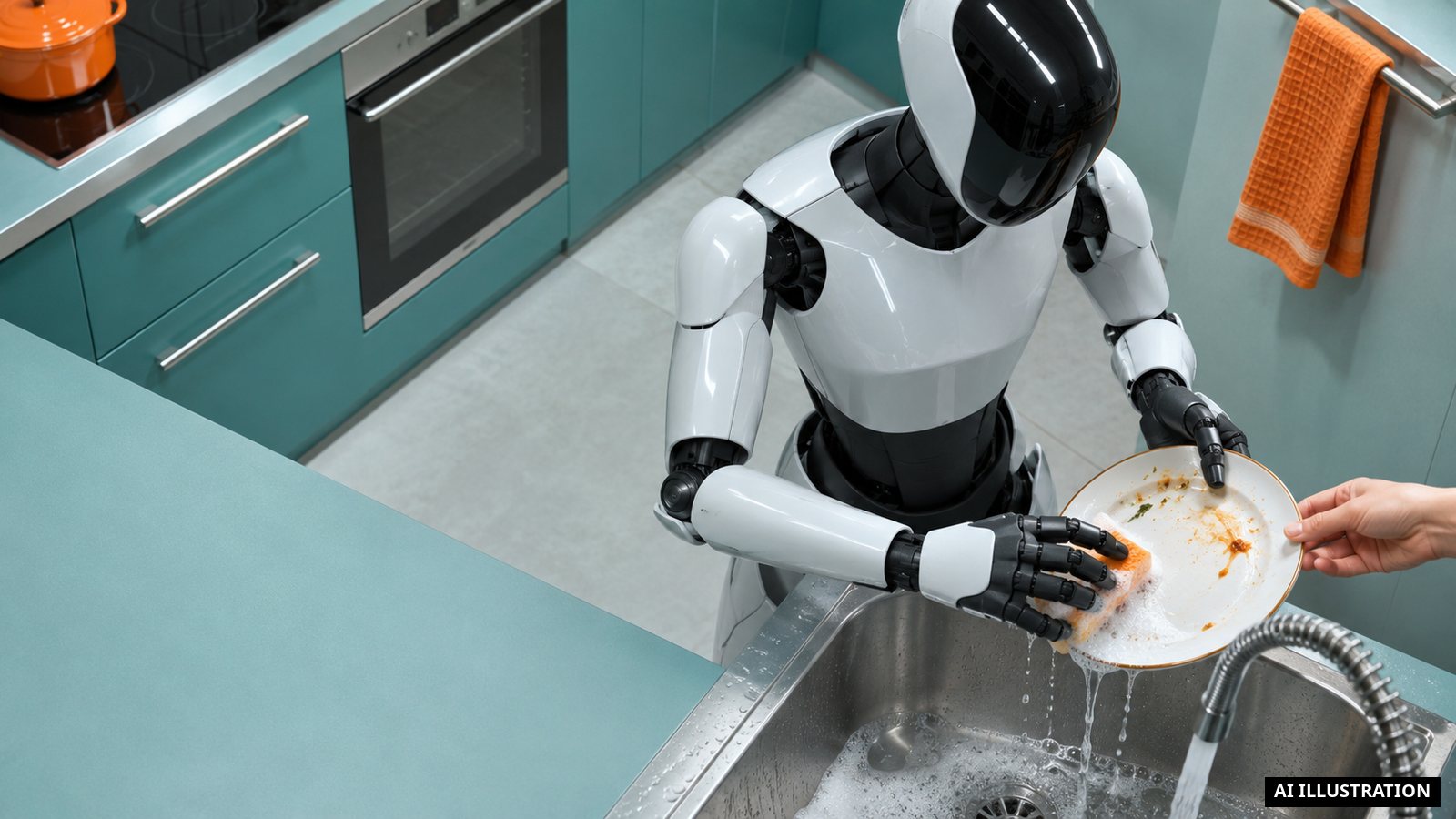
Evening falls. The pile of dishes grows. You turn around, and there, a metallic arm deploys. It grabs the plate, washes it, puts it away. No magic. Just metal and electricity. According to Elon Musk, this type of task could become possible in 12 to 18 months (TIKR.com).
This is not a science-fiction film. It is a projection. And it changes everything. Because if the robot takes the place of your hands, what happens to your privacy? What happens to your home?
The promise: a silent ally in the kitchen
Elon Musk stated that the Optimus robot will be capable of performing household tasks such as taking out the bins, washing the dishes and putting plates away in the cupboards within the next 12 to 18 months (TIKR.com). It is concrete. It is everyday. It is the detail that exhausts you every evening.
Think of your mother. Of her aching knees. And what if, perhaps tomorrow, a biomimetic arm took over? The Optimus Gen 3 model is equipped with 37 joints and hands capable of fine manipulation (m.sohu.com).
Imagine the scene: the robot empties the kitchen bin. It puts away the glasses. It cleans the sink. You read. You breathe. Time stops. It is the dream. But the dream has a price. The price of trust.
The test: a real demo, but not yet in your home
A new demonstration of the Optimus robot is scheduled within the next one to two months (m.sohu.com). It will be “real”, showing the robot in daily interactions, without being a pre-orchestrated spectacle (m.sohu.com). No choreography. No hidden wires. Just the robot, facing the task.
This test is crucial. Because until now, we have seen robots dance, walk, fall. We have not seen a robot live. The demonstration in December 2026, at the humanoid robots summit in San Mateo, California, will be the moment of truth (m.sohu.com). The Optimus Gen 3 model will be presented live there (m.sohu.com).
And if this demo succeeds? And if the robot puts away a cup without spilling it? Your heart races. You want this robot. You want this peace. But wait. Look at where the robot is today. It is not in your living room. It is in a factory.
The brake: the factory, the data and industry before your living room
Since the third quarter of 2026, Tesla has been producing Optimus robots in small series at its Fremont factory (m.sohu.com). The factory currently produces several hundred robots per week, which is about 10 times more than in the second quarter of 2026 (m.sohu.com). It is a ramp-up. But an industrial ramp-up.
The robots produced are not delivered to external customers. They are used inside Tesla to collect training data and on the production lines (m.sohu.com). This is where the real work happens. The robot learns by falling. It learns by missing. It learns in the noise, heat and repetition of the factory.
Tesla is building a dedicated factory for Optimus production in Giga Texas, whose total area exceeds 7 million square feet (m.sohu.com). As of 18 November 2026, the assembly of the main structure was at approximately 65% completion (m.sohu.com). Initial production is scheduled for late 2026, with large-scale production in the summer of 2027 (m.sohu.com).
The first deliveries to external companies are expected towards the end of 2027 (TIKR.com). And according to Elon Musk, it would take at least a year, perhaps a little more, to reach a production of 20,000 robots per week (TIKR.com). He estimated that it would take 20 to 30 million robots to match American production (TIKR.com).
It is the logic. The factory is more tolerant of error than a home. If a robot drops a metal part, it is picked up. If a robot spills a cup of coffee on a child, trust is broken.
So, in 12 to 18 months, the robot may do the dishes. But it will be in a factory. In a warehouse. In a place where error is a cost, not a tragedy. Your home does not have that luxury. Your home has walls that hold your secrets. And a robot that enters your home is a stranger learning to know your habits. Your rhythms. Your silences.
And what if, perhaps tomorrow, the robot looked at you while putting away the plates? And what if, in 18 months, you had to choose between fatigue and the presence of a stranger in your privacy? The dishes are a chore. But trust is fragile. And it does not wash like a plate.