On 6 October, the atmosphere in the chamber was electric. MP Lee Jeong-heon did not ask a verbal question. He physically placed robots from Chinese companies Unitree and AgiBot on the parliamentary audit table (The Gadgeteer, The Korea Times). His aim? To question the government on South Korea’s competitiveness in physical AI. The scene was brutal. This is no longer science fiction. It is geopolitics applied to your schedule.
Imagine your office. Or your kitchen. Or the factory where you work. Chinese machines are already there. They do not just shine under the spotlights. They serve, they tidy up, they produce. And they learn. By observing what is happening in Seoul, one understands that the prototype of your next colleague is already taking shape, far from your sight.
The café robot: it serves, it tidies, it tests
We are no longer talking just about cold mechanical arms. We are talking about presence. Ubtech’s humanoid robot U1 was delivered to Galaxy Robot Park in Seoul last month (The Gadgeteer, The Korea Times, ad-hoc-news.de). It measures 1.68 metres. It has a feminine appearance. Its price? Approximately 170 000 yuan, or 25 000 dollars (The Gadgeteer, The Korea Times, ad-hoc-news.de). That is the price of a used car. That is the price of a modest industrial investment. And it is there, in a park, ready to be observed.
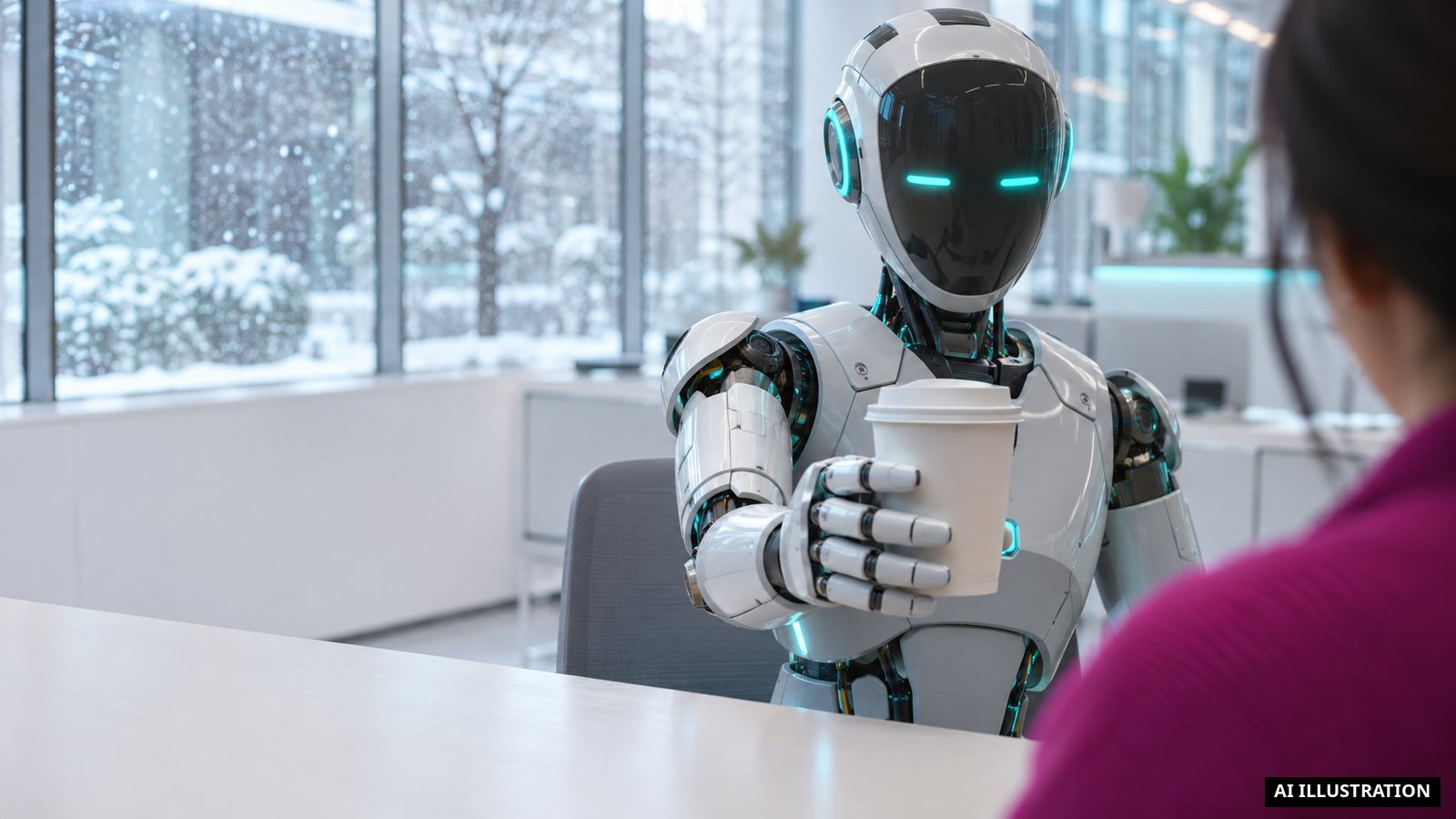
Further afield, in the streets of Seoul, the start-up Anyverse Dynamics, founded in Beijing, is collaborating with the South Korean coffee chain Hollys (The Gadgeteer). What do their robots do? They serve drinks. They clear tables. Imagine your lunch break. You order an espresso. A silent, articulated arm brings it to you. No smile, no fatigue. Just efficiency. This is the public test. If it works in a crowded café, it will work elsewhere.
The South Korean government is striving to build a physical AI ecosystem (South China Morning Post). But Chinese players are already on the ground. UBTech Robotics, Anyverse Dynamics, AgiBot, Unitree Robotics: all have tested humanoid robots or announced projects in South Korea this year (South China Morning Post). This is not a rumour. It is a fundamental trend. Chinese companies are testing their machines in factories and cafés (South China Morning Post).
South Korean Deputy Prime Minister Bae Kyung-hoon admitted on 13 October that China is deploying more humanoid robots in the field and collecting data (The Korea Times). Every move made by these machines is a lesson. Every error is corrected. Every interaction is recorded. Your morning coffee may already be a data point for a Chinese algorithm.
The South Korean factory: 500 AI factories by 2030
The café is the entry-level segment. The factory is the heart of the system. The South Korean government has proposed 3.1 trillion won, or 2.34 billion dollars, in funding for physical AI in 2027 (The Korea Times). This is more than triple this year’s amount (The Korea Times). Money is flowing freely. Why? Because productivity is at stake.
The Ministry of Trade, Industry and Resources’ M.AX programme aims to support the adoption of AI and factory trials of robots (The Korea Times). The goal is clear: 500 AI factories by 2030 (The Korea Times). And mass production of humanoid robots from 2029 (The Gadgeteer, ad-hoc-news.de). The figures are already there. More than 170 factory sites have received support from the M.AX programme (The Gadgeteer). The result? An average increase in productivity of 30 % and a decrease in the defect rate of 15.5 % (The Gadgeteer).
Imagine your workstation. You are an operator. You are a technician. You are a manager. These 30 % productivity gains may mean your job disappears. Or your workload doubles. Robots do not replace humans. They complement them. Or they supplant them. The line is thin. In July, Ubtech announced plans to test humanoids on an automotive parts production line in Korea with its local partners Duksan JM Robotics and AJIN Industrial (The Gadgeteer, The Korea Times, ad-hoc-news.de). Automotive parts. This is the heart of the industry. This is where precision matters. This is where error is costly.
Local giants are not sleeping. Samsung Electronics established its Robotics eXperience division in July, targeting manufacturing before expanding to homes and retail (The Korea Times). Hyundai Motor Group has begun training Boston Dynamics’ Atlas humanoids on its factory campus in Georgia (The Korea Times). Deployment is scheduled for 2028 in manufacturing (The Korea Times). Hyundai plans to deploy approximately 25 000 Boston Dynamics Atlas robots in its Hyundai and Kia factories over the coming years (The Gadgeteer). Twenty-five thousand. This is no longer an experiment. It is an army of silicon and metal.
What if your job was the next test site?
South Korea is not an isolated island. It is a laboratory. China exported 16 559 robots to 108 countries and regions during the first nine months of 2026, for a total value of 206.95 million dollars (The Korea Times). South Korea was the third largest export market for China’s ‘intelligent bionic robots’ during this period, with 20 million dollars in exports (The Gadgeteer). Chinese manufacturers exported 16 559 units of robots, humanoids and robot dogs to 108 countries (ad-hoc-news.de).
The figures speak for themselves. According to Morgan Stanley, approximately 90 % of the 13 000 to 16 000 humanoids delivered worldwide in 2025 came from Chinese manufacturers (ad-hoc-news.de). China dominates the market. And it is testing its machines where the industry is most advanced: in South Korea. According to EY, 73 of the 182 companies funded for embodied AI are already active abroad and 21 are preparing their market entry, totalling approximately 51.6 % (ad-hoc-news.de). The globalisation of robotics is underway.
What does this mean for you? If you work in manufacturing, you are on the front line. If you work in hospitality, you are on the front line. If you work in retail, you are on the front line. Robots are not coming to replace you overnight. They are coming to support you. At first. Then to monitor you. Then to replace you. The transition is fluid. It is invisible. It happens in the background noise of your daily life.
MP Lee Jeong-heon brought these robots to Parliament for one simple reason: urgency. South Korea must remain competitive. It must innovate. It must adapt. And you? You must also adapt. Because the robot serving coffee in Seoul today is the same one that will tidy the factory tomorrow. And the one tidying the factory tomorrow may be the one managing your career the day after.
China exports. Korea imports. The world observes. And you? You are at the centre of this equation. Your work, your home, your life. Everything is connected to this new reality. Robots are no longer objects. They are actors. They have an appearance. They have a price. They have a purpose. And they are already here. The question is no longer ‘if’. The question is ‘when’. And above all: ‘how will you prepare for it?’
Imagine. Tomorrow, you enter your company. A robot greets you. It knows your name. It knows your preferences. It knows what you did yesterday. It knows what you need to do today. Is it frightening? Is it fascinating? Is it inevitable? The answer lies in your next move. In your next decision. In your ability to evolve with this technology. Because the robot does not sleep. It does not complain. It does not take holidays. It learns. And it gets better. Every day. Every hour. Every second.
The coffee is served. The table is cleared. The factory is running. The robot is there. And you? Are you ready?