
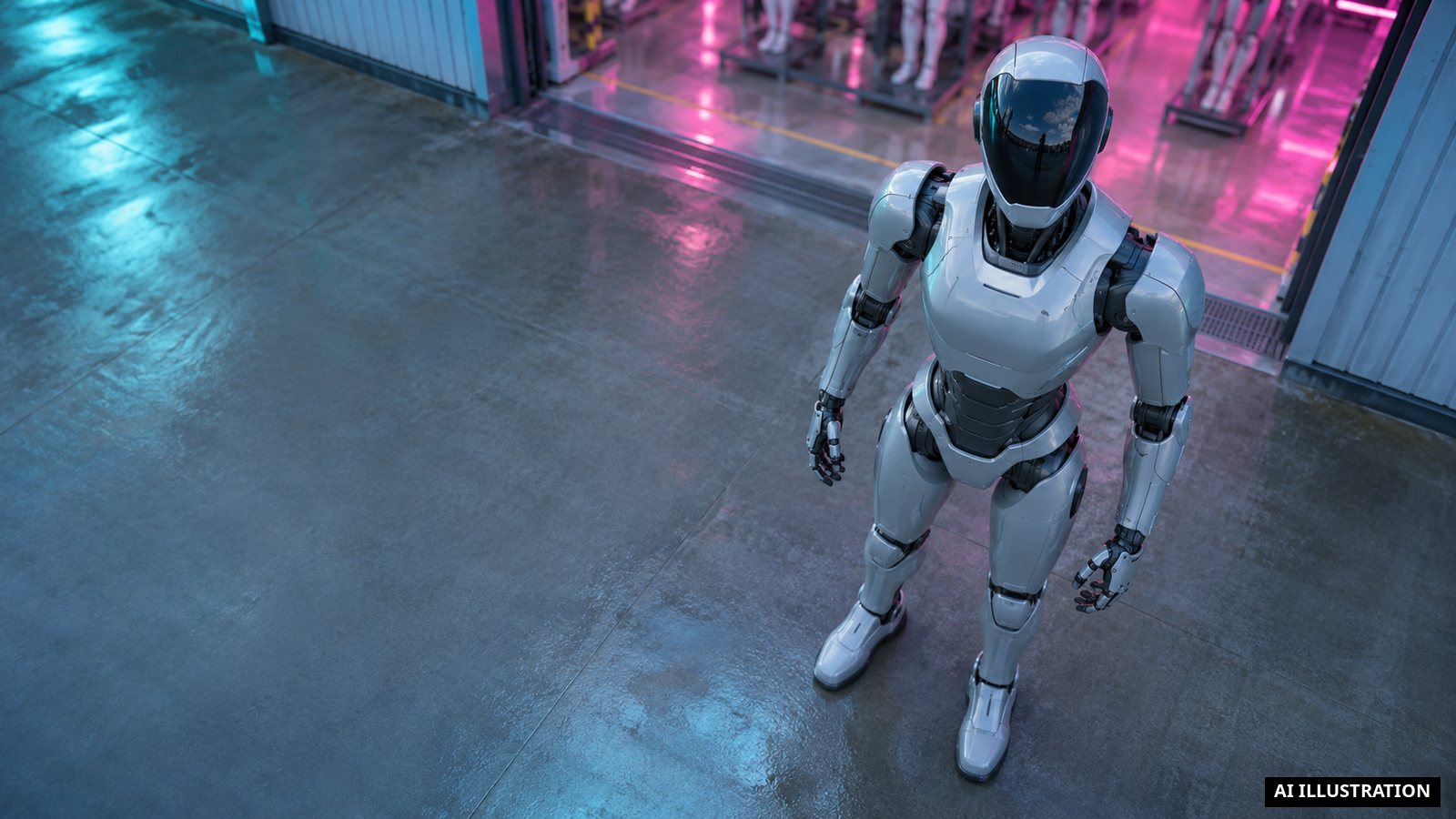
The floor vibrates slightly. It is not an earthquake. It is the steady pace of thousands of machines coming to life in a cold hall, near Munich. In Fürstenfeldbruck, a new factory began operations at the start of 2026. The objective is clear: to produce 10 000 legged and wheeled humanoid robots each year (The Robot Report).
This is not a model. It is not a fragile prototype sitting in a display case. And it is in Germany. The company driving this project is called Agile Robots. It recently raised 500 million dollars in a Series F round on 12 November 2026 (The Robot Report). With this sum, the company’s valuation reaches 8,5 billion dollars. It thereby becomes the most valuable robotics startup in Europe (The Robot Report).
500 million to bring the robot into the factory
Where does this money go? Not into safes. The funds raised will be used primarily for the expansion of operations in the United States, increased investment in research and development, and the extension of production capacity in Germany (36kr.jp). It is a race against the clock. Agile Robots plans to produce approximately 2 000 robots in 2026. The following year, production is expected to increase by 2 to 3 times (36kr.jp).
Who is financing this machine? SoftBank Group led the funding round. NVIDIA, the Hitachi group, and T.Capital, a subsidiary of Deutsche Telekom, are also participating (The Robot Report). These are giants of tech and industry. They are not betting on an idea. They are betting on infrastructure. They know that the robot will not stay in the laboratory. It must go out. It must work. It must be where you are.
Imagine your company. Not the one of your dreams, but the one where you send your emails on Monday morning. Imagine that tomorrow, one of these robots enters your open-plan office. It is not coming to replace you, at least not just yet. It is coming to help you. Or it is coming to take your place. The line is thin. And it is being drawn now, in this factory in Bavaria.
Audi tests parts sorting: what if your job is next?
The robot is no longer theoretical. It is already in action. In October 2026, Agile Robots announced the completion of a proof of concept with Audi, a subsidiary of Volkswagen. In the Ingolstadt factory, mobile humanoid robots are testing the automatic sorting of automotive parts (36kr.jp).
Look closely at this image. Car parts. Metal objects, sometimes heavy, sometimes fragile. A robot sorts them. It identifies them. It stores them. It is repetitive work. It is work that many employees do today. In warehouses, in workshops, on assembly lines. If the robot can do it, why not you?
The question is no longer “can the robot do this job?”. The question is “will the robot do it in your place?”. Parts sorting is a first step. But it is a step inward. Towards offices. Towards administrative tasks. Towards stock management. Towards internal logistics. Your profession, whatever it is, relies on tasks. Some are creative. Others are repetitive. The robot targets the latter. And it is very good at this.
What if your job is next? Not tomorrow. Perhaps in two years. Perhaps in five. But the signal has been given. The robots are coming out. They are going into factories. Then they will go into warehouses. Then they will go into offices. The chain has been set in motion.
20 000 robots already deployed: what if the robot became your colleague?
Do not believe that this is just a beginning. Agile Robots has already deployed 20 000 industrial robots for clients in the automotive, consumer electronics, and logistics sectors (The Robot Report). Twenty thousand machines. They are already working. They do not sleep. They do not take holidays. They do not complain.
Imagine your working day. You arrive. You drink your coffee. You open your computer. Next to you, a robot is at work. It does not speak. It does not smile. It executes. It is your colleague. Not a human. A machine. But a colleague nonetheless. It shares your space. It uses your tools. It responds to your commands.
Does it scare you? Perhaps. Does it make you dream? Perhaps too. Dreaming of a world where onerous tasks disappear. Dreaming of a world where you can focus on what matters. On creation. On the human element. On yourself. But this dream has a price. That price is the transformation of your profession. The disappearance of certain tasks. The emergence of new skills. The need to adapt.
The robot is not an enemy. It is a tool. But it is a powerful tool. A tool that changes the rules of the game. And you are at the centre of this game. Your home, your partner, your children, your parents, your work. Everything is connected. If your work changes, your life changes. If your life changes, your home changes. If your home changes, your relationship changes.
So, what do you do? Do you watch the train go by? Or do you get on it? They are coming. They will knock on your door. Or they will walk straight into your office. What if your profession changed? Not tomorrow. Perhaps today. Perhaps now. The countdown has begun.