
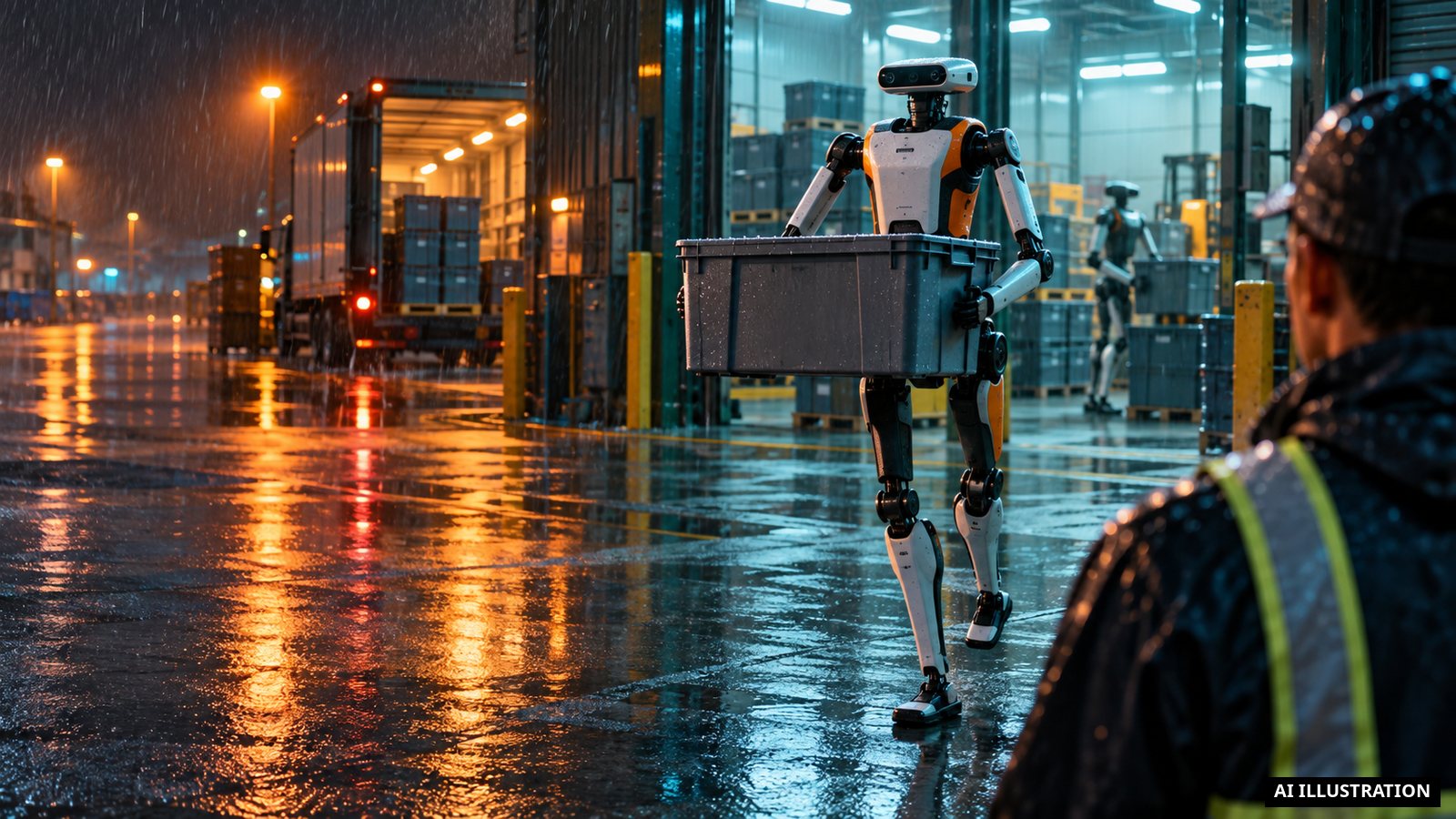
In the small world of humanoid robots, we have become accustomed to grand spectacles: machines running in heavily edited videos, demonstrations that go viral on social media. And then there is Digit, the robot from American manufacturer Agility Robotics. It does not dance, nor does it run in a slick clip. It moves totes in warehouses. And perhaps that is exactly why it is winning.
A new client, without the fanfare
On 10 December 2025, Agility Robotics and Mercado Libre — the major online sales site in Latin America, a sort of local Amazon — announced a commercial agreement to deploy the Digit robot. No viral video, no robot performing acrobatics: just a contract. According to Agility, the robot will be installed in an order fulfilment centre (the warehouse where parcels are prepared before dispatch) located in San Antonio, Texas.
According to The Robot Report, Digit will initially focus on tasks supporting order preparation, most likely the handling of totes — these plastic crates, called totes in the jargon, which pass through warehouses by the thousands.
The only figure that matters this week
Here is the detail that changes everything. At the time of this announcement, Digit had already moved over 100,000 totes in real commercial operations, according to Agility Robotics. Not in a demonstration, not in a laboratory: at real clients, in real warehouses, with real orders to prepare.
This is a huge difference from what we see elsewhere at the moment. During this same period, other humanoid robots are mostly making headlines for their visuals: one runs beautifully in a video, another recentres on the factory after promising the salon. They tell a story. Digit, for its part, stacks up a figure.
Mercado Libre joins an already established club
According to Agility, Mercado Libre is being added to a list of clients who already use Digit, among which are reportedly GXO Schaeffler (a logistics specialist for third parties) and Amazon. In other words, the new entrant is not betting on a promise: it is choosing a robot already proven with major players in warehousing.
This poses a simple question, but one that slightly disrupts the usual narrative: did Mercado Libre retain Digit for its technical feats, or simply because it is one of the few humanoids already tested at scale in real-world conditions? When you have to keep a warehouse running, you often prefer the machine that has already proven itself to the one that impresses in a video.
What this unassuming worker looks like
Physically, Digit has nothing of a cinema athlete. According to The Robot Report, it stands at approximately 1.75 metres (5 feet 9 inches), weighs around 64 kilograms (140 pounds) and can lift up to 16 kilograms (35 pounds). Enough to handle totes all day long, and no more. It is far from the robot that lifts spectacular loads or runs the marathon. It is a worker, not a star.
The true market split
We tend to believe that the competition between humanoid robots pits those who run against those who dance, those who put on the most impressive demonstrations. But the real divide may lie elsewhere. On one side, robots that put on a show — and for whom we are still waiting to see the real work. On the other, a robot that puts up the number, discreetly, tote after tote.
The criterion of seriousness in this sector may be shifting: no longer the number of views on a video, but the number of totes actually moved in the warehouse. If that is the case, then the most boring robot of the moment is also, paradoxically, the one gaining the edge. It remains to be confirmed in the coming months whether these 100,000 totes will translate into a lasting presence in our supply chains — or whether the fashion for humanoids will fade as quickly as it rose.