
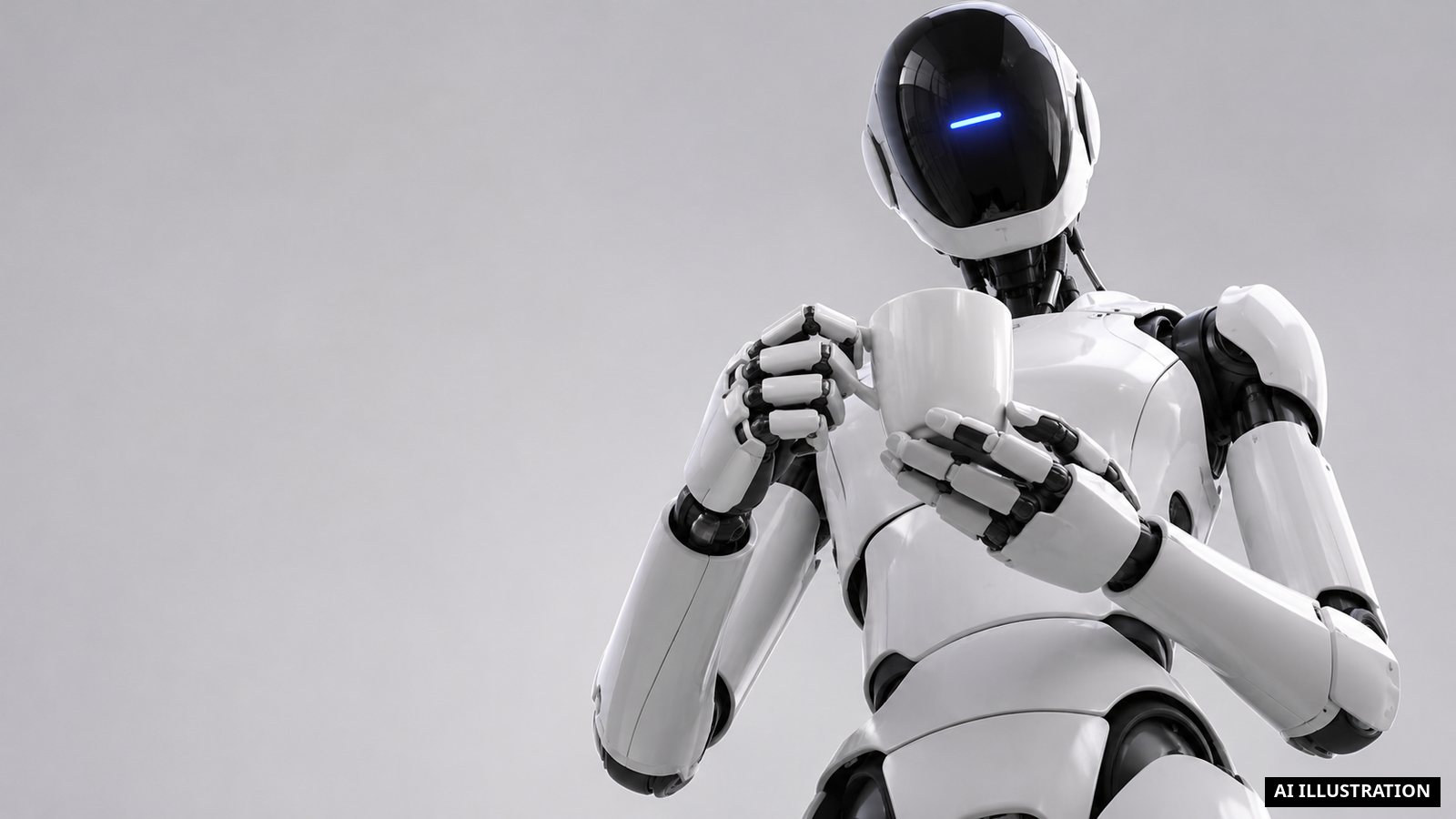
Before him, a 1.5-metre silhouette looks at him. This is not an actor. It is Max, a 48-kilogramme humanoid robot prototype (01net.com). It was built in three months, in partnership with the Chinese robotics company Fourier (01net.com). The air is charged. This is not a living room gadget. It is a machine designed to manipulate small objects with five-fingered hands (Capmad).
Three months, 48 kg, and a face that looks at you
The speed of development is staggering. Meta did not design this robot from scratch. The hardware is customised from Fourier’s existing humanoid platforms (Yahoo Tech). Meta’s engineers worked with their Chinese counterparts in Shanghai during this process (Capmad). The result is a machine that weighs 48 kg and relies on the NVIDIA Jetson Thor robotic computing platform (01net.com). It is a powerful brain, but the body remains that of a prototype.
Max has a face. It features a facial display capable of imitating expressions (Capmad). This ability to mimic human expressions creates an immediate, almost unsettling connection. You are no longer talking to a tool. You are talking to an entity that simulates attention. It is the first step towards mechanical intimacy.
The dream: fewer chores, but no robot for sale
Why is Meta building this? To help humans with daily household tasks (01net.com). The dream is simple: a robot that tidies, cleans, and relieves. But there is a catch. The company does not plan to commercialise the Max and Max 2 robots to the general public (01net.com). No price. No shop. No delivery to your door.
These robots are intended for experimental use in private homes (01net.com). Imagine the scene: your living room becomes a laboratory. Your housekeeping robot is not a consumer. It is a subject of study. It learns. It tests. It fails. It succeeds. But it does not belong to you. It belongs to the experiment. And what if tomorrow, a Meta employee lived in your home to observe how Max manages your bin? The dream of disappearing chores collides with the reality of scientific observation.
The fear: what if its AI learns your house?
The most unsettling thing is not the metal. It is the intelligence. Meta acquired the startup Assured Robot Intelligence in May (01net.com). This company specialises in AI models enabling robots to understand and adapt to human behaviour (01net.com). Max is not just a mechanical hand.
A second prototype, Max 2, entered development in September 2026 (Capmad). The planned changes include a redesigned torso, improved hands, a projector, and additional sensors (Capmad). These sensors are designed for environmental understanding and navigation on stairs (Capmad). Imagine: Max 2 climbs the stairs in your house. It projects images. It scans every corner. It learns where you leave your keys. It knows when you are tired. It knows when you are alone.
No public launch date or consumer product roadmap has been reported for Max or Max 2 (Yahoo Tech). The silence is deafening. We do not know when this will happen. We do not know who will be chosen to host these prototypes. But the technology is here. The face is here. The hands are here. The question is no longer 'when can I buy this robot?'. The question is: 'do I want my robot to look at me while it tidies my house?'
Perhaps tomorrow, housework will no longer be a chore. But it will become surveillance. And what if the robot that tidies your house was not a product for sale, but an experimental prototype in private homes? The fear is not in the machine. It is in the gaze it casts upon you.