
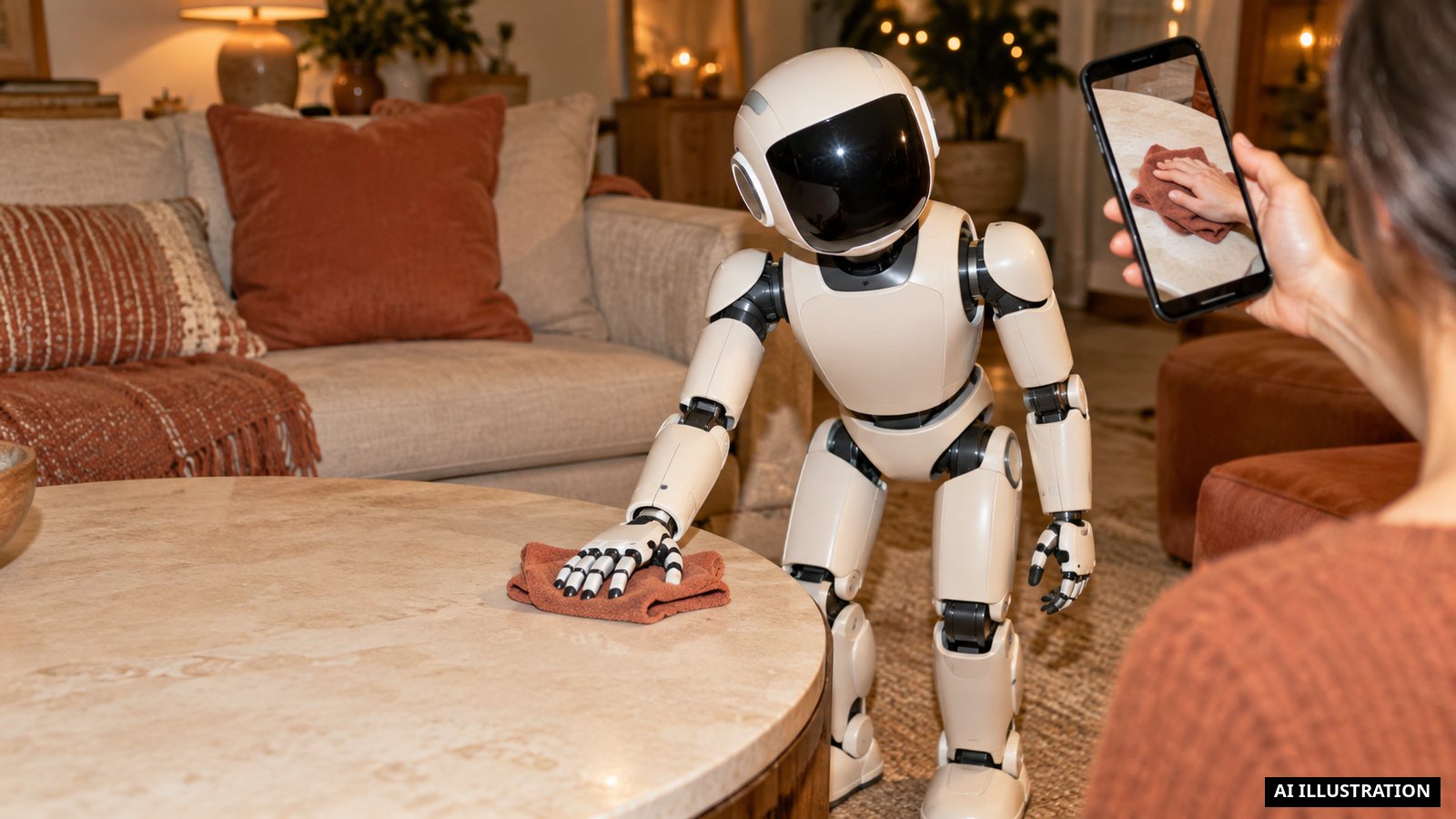
You are sitting on the sofa, phone in hand. In front of you, a small humanoid, 1.09 metres tall (CNET), is looking at you. You do not give it a voice command. You do not trace a code. You simply show it, through your smartphone screen, how to wipe a stain on the table. You move the phone as if it were your hand. The robot observes. An hour later, it performs the gesture alone. No remote pilot, no wires. Just it, in your living room, having understood.
This is not science fiction. It is the Flourish 1, announced by the startup Flourish, based in San Francisco and Paris (CNET). The price? $3,555. A figure that makes you pause, but which changes the game for the domestic robot. The company opens pre-orders for the first 50 numbered units on Tuesday, 29 September 2026. Deliveries are scheduled for December 2026, just before Christmas (CNET). Imagine the gift under the tree: not a toy, but an assistant that tidies up.
Learning in thirty minutes, acting autonomously
How does it work? This is where the phone becomes your training tool. According to the mobile application, you act as a teleoperator. You use your phone as a proxy object to demonstrate the task (CNET). The robot learns in thirty minutes. That is short. The time for a coffee, or a TV series episode. Then, it takes an hour to internalise the process. An hour of silence, calculations, and virtual repetitions. Then, it can perform the task autonomously (CNET).
The CEO and founder, Antoine Marcel, specifies that there is no human operator controlling the robot remotely during its normal operation. The learning videos are erased after use (CNET). Your privacy stays with you. It learns, it acts, it forgets the video. It keeps the gesture.
On simple tasks, the robot successfully completes its mission about 80% of the time. The company aims for 99% success for learned tasks (Clubic). It is not perfect. It is human. Or rather, it is robotic. It will miss a crumb. It will hesitate. But it will tidy up. And that is already a lot.
The limits: what it will never do
It must be clear. This robot is not a superhero. It does not carry more than 1.5 kg. It does not handle fragile objects (CNET). Why this limit? According to the company, the majority of domestic tasks do not require more. It is a design choice. A safety choice. A cost choice.
It does not do the dishes. It does not wash the dog. The first generation is not waterproof (The Robot Report). It is suited to tidying, the bin, and basic cleaning such as wiping a table (The Robot Report). No complex assembly. It is there for the everyday, the repetitive, the tedious. The kind of task that makes you say "I will do it later" and which ends up rotting on the counter.
The robot measures approximately 1.09 metres in height, weighs around twenty kilos, and has a reach of 35 inches, or about 89 cm (CNET). It is small. It is light. It is discreet. It does not dominate the room. It integrates. It is designed and assembled in Paris (Clubic). It is a French object, born in Parisian offices, that will enter American and European homes.
A 12-hour companion
The robot can operate for 12 hours (The Robot Report). That is a working day. It does not sleep. It does not complain. It uses a small lidar located near the ground for obstacle detection (The Robot Report). Your cat passing in front? It stops. Your child running? It stops. Safety is paramount.
The heart of the system is a Raspberry Pi. It is a pocket computer, not a supercomputer. This reduces the cost of the component list (The Robot Report). For intelligence, it uses cloud GPUs for training and inference. It needs a network connection. Without internet, it is mute. It is frozen. It is a dependency. But it is also what makes it affordable. The power is in the cloud, not in the battery.
The company was founded in January of this year, less than 12 months before its market launch (The Robot Report). It is fast. Very fast. Others have taken years. The robot is here. It is real. It is numbered. The first 50 lucky ones will have it under the tree.
And if, tomorrow, you no longer had to wipe the table? And if, before Christmas, you could offer your family a moment of calm, a clean living room, one less chore? The robot does not love you. It does not hate you. It executes. But it frees. It frees time. Time for you. Time for your children. Time to breathe.
On 29 September 2026, pre-orders open. 50 units. Numbered. Exclusive. Do you want to be among the 50? Or do you want to wait for the next wave? The robot waits. It has 12 hours of energy. It has 1.09 metres of patience. It has $3,555 of value. And it has a task in mind: to make your life a little simpler.