
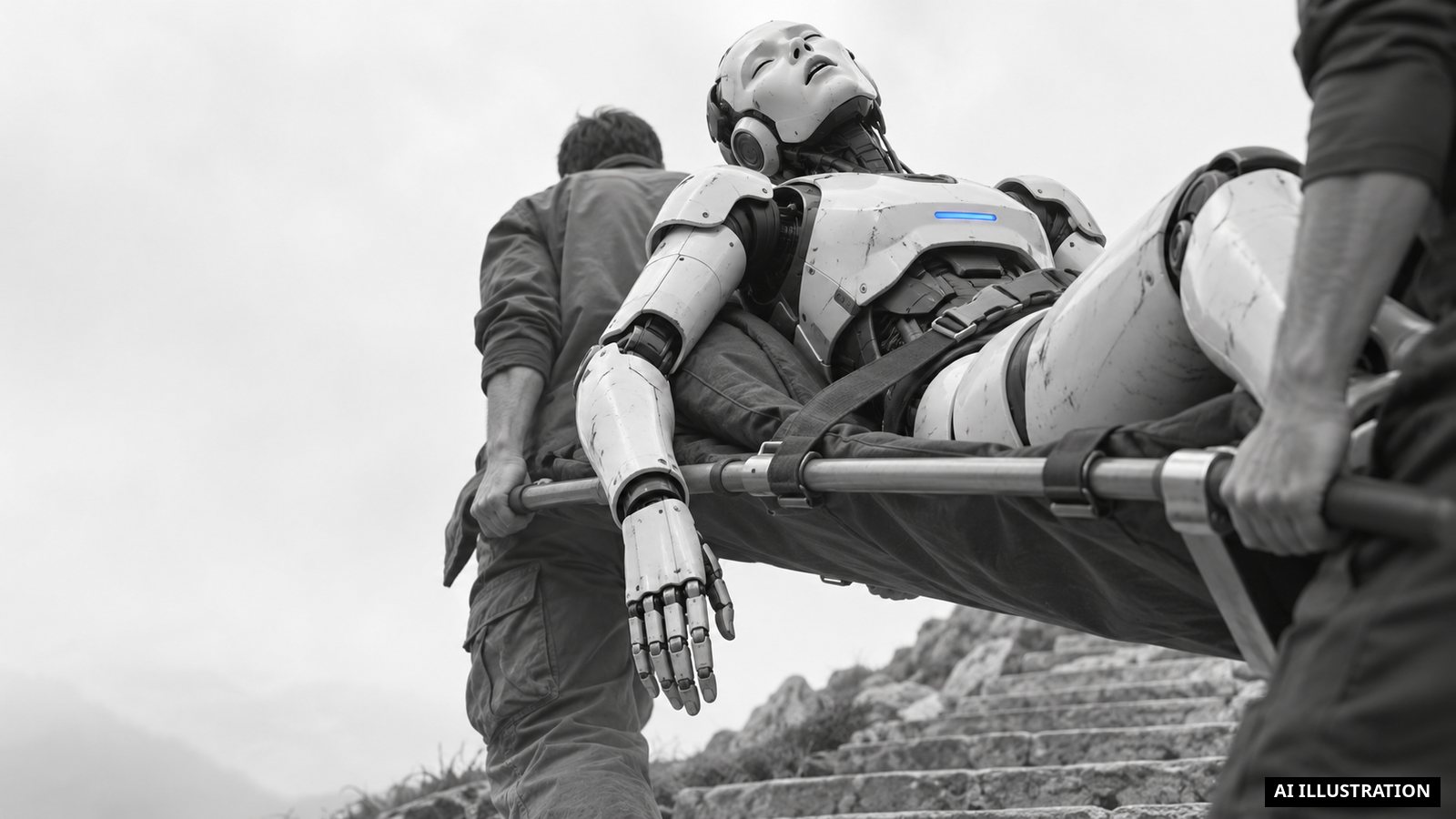
On 2 November 2026, the cold air of Shandong province was not enough to mask the heat emanating from a machine. On the steep slopes of Mount Tai, a Unitree G1 humanoid robot came to a halt. Its circuits were heating up. It would not complete its journey alone. Human hands took over. It was evacuated on a stretcher, like an exhausted mountaineer (Gadget Review, Interesting Engineering, Tech Times UK).
This was not an anecdotal malfunction. It was a crack in the mirror of our future. We often imagine robots as inexhaustible entities, capable of doing anything, anywhere, at any time. But on that day, the machine showed that it had a body. And that this body, too, has its limits.
The journey that made the difference
To understand the scale of the near-exploit, one must visualise the effort required. The competition, organised by the public audiovisual group CMG, was not a simple stroll across the plains (La Presse). The course covered 3.9 kilometres. But this figure does not tell the whole story. There were more than 3,000 steps to climb and 600 metres of elevation gain to absorb (Gadget Review, Interesting Engineering, La Presse, Tech Times UK).
Imagine this ascent. No treadmill, no gentle slope. Just steps, one after another, under the weight of the machine. It is a sustained effort, comparable to that of an endurance runner climbing a mountain. Among them, a canine robot designed by Beijing Lingyi Technology, a subsidiary of Unitree, proved that endurance was possible. It won the speed event in 43 minutes and 41 seconds (Gadget Review, Interesting Engineering, La Presse, Tech Times UK).
The contrast is striking. The four-legged robot kept the pace. The humanoid robot, however, broke down. Why? Perhaps because standing upright and walking on two legs is a far more complex and energy-intensive task than running on four. The bipedal body, even in metal, consumes more. It gets tired. And when it gets tired, it overheats.
The stretcher: a perhaps missed adjustment
The robot evacuated was not a secret prototype. It was a development version of the G1, the same model presented at the Chinese New Year gala (Gadget Review, Interesting Engineering, Tech Times UK). A robot already known, already seen, but perhaps not ready for this specific challenge.
Unitree, the manufacturer, put forward a hypothesis. According to the company, the robot may have participated in the competition without appropriate settings (Gadget Review, Interesting Engineering, Tech Times UK). This claim sparked online debates about the actual endurance of humanoid robots. But Unitree did not provide any additional technical details about the overheating incident. The specific component responsible for the temperature rise was not identified (Gadget Review, Interesting Engineering, Tech Times UK).
One report even identified the robot as belonging to the Yongda Zhicheng team rather than an official submission from the Unitree factory, although this attribution was not corroborated by a second independent source (Gadget Review). Amid the uncertainty, one certainty remains: the machine reached its thermal limit. And this limit is physical, inescapable.
Will your future robot have the same endurance?
Tomorrow, perhaps, a robot like the G1 will enter your living room. It will not climb Mount Tai. But it will have to walk on your tiles, cross your kitchen, carry your groceries. And if, one day, it has to climb the stairs in your house?
If the robot has physical limits, it will need rest. It will need cooling. It will need to be ‘evacuated’ from its task if the load becomes too heavy. Will you accept it stopping in the middle of the room, overheated, waiting for you to help it?
The Mount Tai incident reminds us of a simple truth: technology is not magic. It is physical. And the laws of thermodynamics apply to circuits too. When you welcome your future assistant, ask yourself: has it been configured for your daily life? Or will it, too, end up on a stretcher?