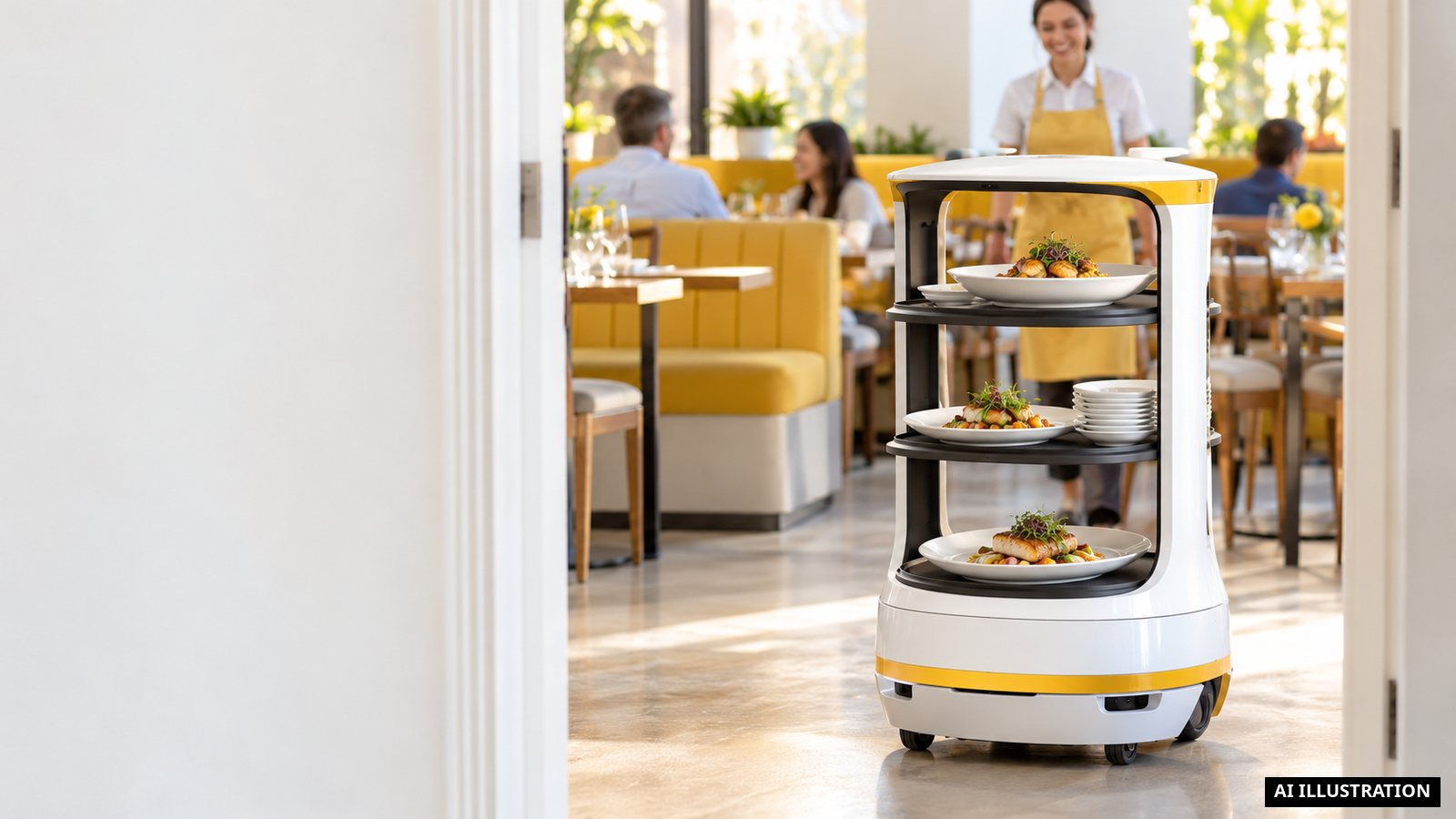
The clatter of plates colliding. The smell of fresh beer. And then, that strange silence in the service corridors. In Sanford, Florida, the German restaurant Hollerbach’s has just tested a novelty that changes the game for its team (WKMG). For three days, a robot named BellaBot has been moving between the walls. It does not smile. It does not look at customers. It has a single mission: to transport orders from the kitchen to the bar (WKMG).
A pre-programmed route, not one less waiter
We often expect humanoid robots to come sit at your table to serve your steak. Here, it is the opposite. BellaBot is described as a "horizontal food elevator" (WKMG). The restaurant already has a vertical elevator connecting the kitchen to the bar located on the roof. But the horizontal link was missing. The kitchen is located 150 feet from the bar area, according to Theo Hollerbach (WKMG). It is a short distance for a human, but it is a distance that accumulates. Legs get tired. Attention scatters.
BellaBot follows a pre-programmed route from the kitchen to the Lodge bar area (WKMG). It does not improvise. It does not get lost. It does not complain about fatigue. It simply glides. The owner claims that this robot allows waiters and bartenders to remain focused on customers instead of making long trips for service (WKMG). That is where the real change lies. The waiter is no longer a courier. He becomes a host again. He can look into the eyes of the person in front of him, rather than looking at his feet to avoid spilling sauce on the floor.
The bartender remains the master of the floor
It is crucial to understand what the robot does not do. It does not deliver the dish directly to the customer. Once it arrives at the bar, the bartender removes the food from the trays and delivers it to the customer (WKMG). The robot is a logistical intermediary. It is the pipe through which the food passes. The human remains the point of contact. The customer does not see a cold screen or a machine placing a steaming dish in front of them. Human warmth remains intact. The robot eliminates physical fatigue, not social interaction.
This system works like an inverted assembly line. The kitchen produces. The robot transports. The bartender finalises. Each link is precise. The robot does not stop to smoke. It does not stop to chat with a colleague. It executes. And it is this cold execution that frees up mental space for the human team.
600 dollars a month, the owner’s calculation
The cost of this innovation is surprising. The restaurant pays 600 dollars a month for the use of BellaBot (WKMG). Is it expensive? For a robot, it is little. For a restaurant, it is a fixed expense. Theo Hollerbach, the owner, explains that this cost is more economical than hiring a food courier for peak hours (WKMG). Employees generally do not come to work for only two hours. You have to pay a minimum wage, manage schedules, holidays. Always.
Imagine your own home. What if you had a robot that only transported your groceries from the parking lot to the kitchen? You would no longer be obliged to carry heavy bags. You would be free to look after your children or your partner. It is the same principle. The robot does not live with you. It does not eat with you. It does not sleep in your bedroom. It performs a repetitive and physical task that frees you. It gives you back time. Quality time. Time to breathe.
Three months to find out if it works
The trial is underway. Theo Hollerbach plans to use the robot for the next three months to evaluate its efficiency during Oktoberfest and other events (WKMG). It is the ideal time to test such a system. Oktoberfest means crowds. It means pressure. It means noise. It means fatigue. If BellaBot can keep up the pace during these intense weeks, then it has proven its worth. If the waiters are less exhausted, if service errors decrease, if customers appreciate the smoother service, then the verdict will be clear.
And what if, tomorrow, this type of robot existed in your favourite restaurant? And what if, instead of seeing a breathless waiter cross the room with an unstable tray, you saw a silent robot glide towards the bar? And what if the waiter then arrived, fresh, smiling, ready to serve you? Technology does not replace the human. It relieves them. It gives them back their energy. It gives them back their smile. Perhaps that is where the future of service lies. Not in total robotisation, but in the division of labour. The machine makes the journey. The human makes the connection. And you, you enjoy the meal. Without stress. Without waiting. Just the pleasure of the table.