
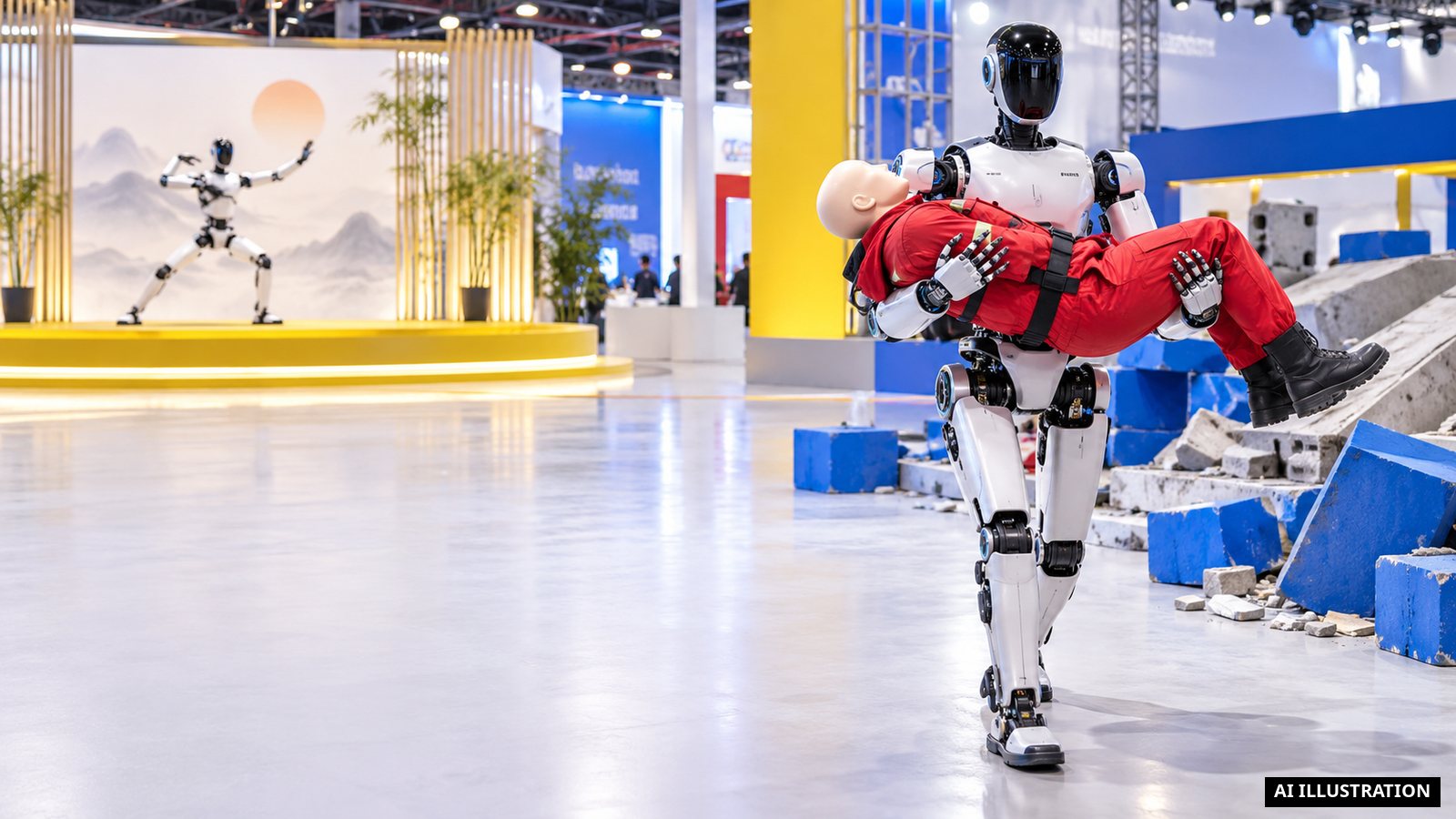
On 13 December 2025, the opening ceremony of the Global Developer Pioneers Summit in Shanghai offered a striking image: a robot dressed as a lion walking on flower-decorated poles to the rhythm of drums, and another, in white attire, performing Tai Chi postures alongside human martial artists. The first is the Lingxi X2 by AgiBot, which simulated a lion dance troupe; the second is the G1 by Unitree, which performed “Wild Horse Parts Mane” and “White Crane Spreads Wings”, according to Yicai Global. The show is impeccable. That is precisely the problem.
A choreography proves nothing — and that is intentional
A dance performed in controlled conditions says nothing about a machine’s actual autonomy. Worse still: it is the only demonstration format in which an observer cannot distinguish between autonomous behaviour and a pre-programmed or remotely controlled sequence. And on this point, the manufacturer itself provides the key.
According to Interesting Engineering, Unitree’s platform offers pre-loaded action routines that include martial arts, a “The Twist” dance, and ballet sequences. The same source indicates that this platform allows robots to be controlled remotely from a smartphone, using the phone’s camera to guide movements. In other words, the exact routines sold as feats on stage — martial arts, dance, ballet — already exist as ready-to-use playlists, and remote control is a documented feature. Nothing allows one to know, from a gala seat, which of the two was at work.
Where Musk gets caught out, the Chinese scene immunises the demo
The comparison with the West is instructive. According to Interesting Engineering, a leaked recording of Tesla’s “Autonomy Visualized” event in Miami shows the Optimus robot becoming unstable while distributing water to participants, then falling over. The same source recalls that Elon Musk had previously dismissed accusations of remote control, claiming that a kung-fu demonstration was a matter of AI and not teleoperation.
The contrast can be summed up in one sentence: a live water distribution or kung-fu performance exposes the machine to the unexpected, and therefore to refutation. A meticulously choreographed routine, never. The spectacle format does not merely embellish the demonstration — it shields it from fact-checking.
The real test was in the room, but out of the spotlight
The irony is that the same event contained the difficult, unscripted trial. According to Yicai Global, the embodied AI competition at GDPS 2025 included an emergency rescue trial on a 10-metre by 30-metre track, where robots had to carry heavy loads, cross 30 cm high debris, and climb 25 cm steps. This was complemented by a domestic services trial: folding laundry and putting away dishes in a home environment.
These are tasks where no playlist exists: the pile of laundry is never the same twice, and debris does not fall at the millimetre planned. This is exactly what should be filmed to judge industrial maturity. It is also what the gala covers with drums.
The figure that betrays the real maturity
Behind the scenes, one detail says a great deal. According to Pandaily, AgiBot’s 5,000th robot — a Lingxi X2 model unit — was not delivered to a factory, but symbolically handed over to the studio of Chinese actor Huang Xiaoming. The showcase robot goes to a film star, not to a production line.
The composition of the fleet tells the same story. According to Interesting Engineering, the X-Series range of agile, half-size bipeds reached 1,846 units produced, and the G-Series range, with wheeled bases oriented towards tasks, 1,412 units. That is, between the two, more than 3,200 machines out of approximately 5,000 — a substantial proportion relating to demonstration formats, data collection, or entertainment rather than operational deployment.
This does not erase AgiBot’s industrial lead. According to Fox News, which cites the research firm Omdia, the company dominated global humanoid shipments in 2025 with 5,168 units out of approximately 13,000 delivered worldwide that year. The volume leadership is real. But “delivered” is not “deployed”, and a shipment ranking does not measure utility.
You do not measure an industry by its choreography
The Shanghai gala is not a demonstration of capabilities. It is a staging designed to keep the question of autonomy undecidable. The dance seduces because it cannot fail in public; rescue and laundry folding are relegated to the background because they could. An industry is not judged by what it chooses to expose under the spotlights, but by what it prefers to leave in the shadows.