
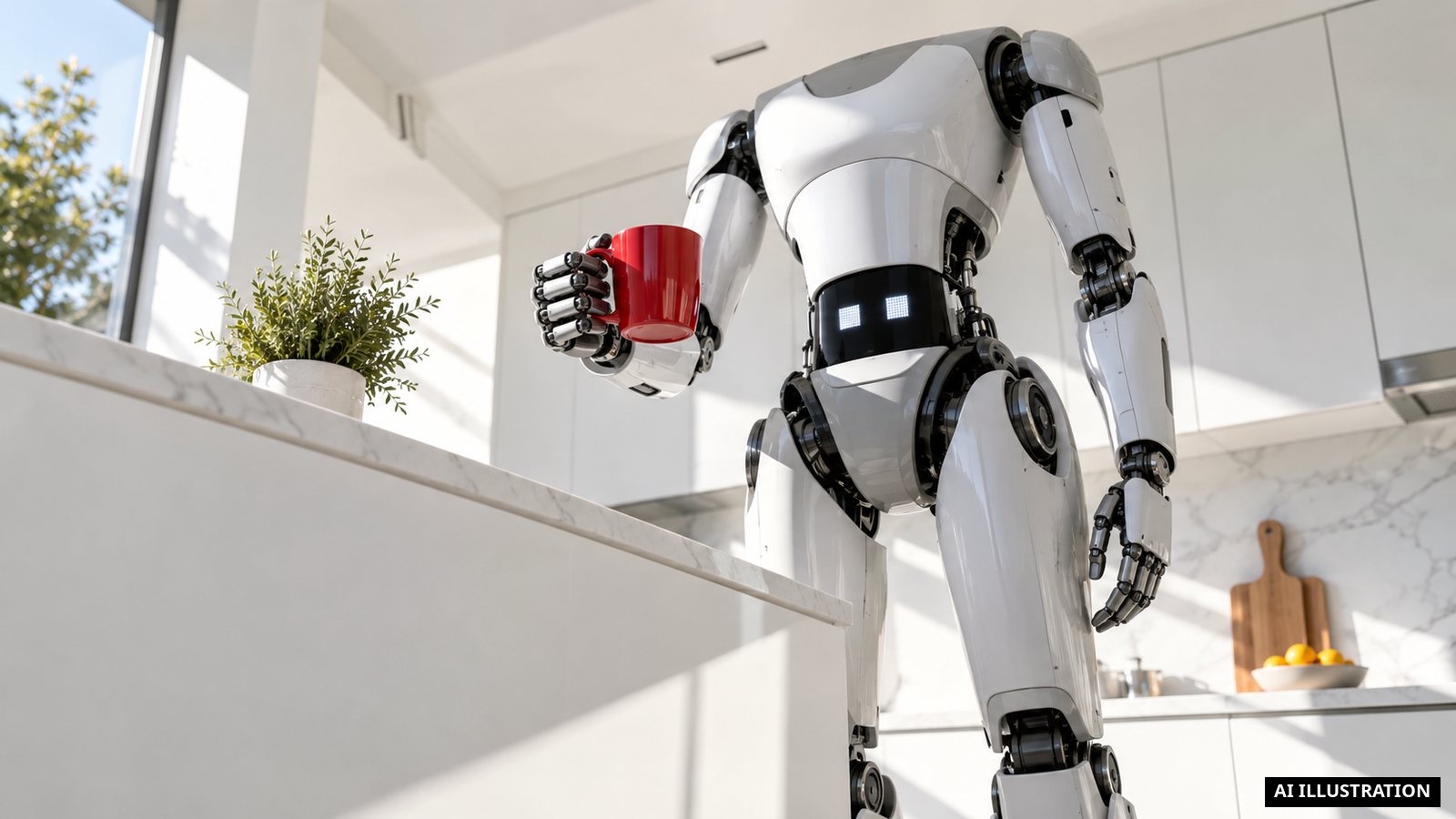
In the launch video, the Voxel Series-1 has no head. Its pixelated eyes are near its waist, its small mouth communicates, and its Z-shaped legs fold backwards. It is strange. It is fluid.
We are not presenting you with a humanoid that imitates your neighbour. We are presenting you with a machine designed to disappear into the background of your life, while remaining visible when it acts.
A headless design, to avoid the uncanny valley
Why no face? Because the human face is a trap. You do not want it to look at you with eyes that seem sad or fake. You want it to do the work.
The Voxel Series-1 has an orange exterior, pixel-style animated eyes near the waist, and a small mouth to communicate with users (Mike Kalil). The robot is devoid of a head and has eyes located on its belly (Interesting Engineering).
Behind this futuristic toy appearance, there is an obsession with detail. To develop the robot’s personality, Tuesday Labs recruited animators with experience at Pixar (Interesting Engineering).
The result? A robot designed to appear polite, slightly anxious, and obsessed with the correct execution of household tasks, according to Rosalind Shinkle (Mike Kalil). Voxel’s movement begins with a 3D animation, similar to that of a Pixar character, and then models trained on this animation reproduce it on the real robot, managing gravity, inclined floors, and shocks (Interesting Engineering).
It tidies up, tells you where your phone is, waters the plants: but who holds the controls?
What if, tomorrow, you come home tired and the kitchen is already tidied? Voxel’s main function is 'home reset'. It learns where objects should be, then puts them back in place (Interesting Engineering). It is designed to indicate where the user last saw their phone, bring back drinks or keys, and water the plants (Interesting Engineering).
Each of the robot’s arms has 7 degrees of freedom and is equipped with simple grippers to pick up and carry everyday objects (Mike Kalil). Voxel’s grippers use a single actuated degree of freedom to grasp, hold, pull, and release household objects (Interesting Engineering). It moves using two Z-shaped legs with knees that bend backwards, a design intended to allow it to reach objects in tight spaces such as kitchen cupboards (Mike Kalil).
The articulated legs allow the robot to get close to worktops, tables, sectional sofas, and shelves, according to Tuesday Labs (Interesting Engineering).
But beware. It is not an autopilot. A human can hold the controls. It operates through a mix of autonomous intelligence and teleoperation (freeyork). It is a collaboration between your home and a remote operator.
Estimated $20,000, 2028, and trial adopters: dream or trap?
The price? Its estimated cost is $20,000 (Interesting Engineering, Mike Kalil, therundown.ai). Reservations for the Voxel Series-1 require a fully refundable deposit of $200 (Interesting Engineering, Mike Kalil, therundown.ai).
The first deliveries of the robot are scheduled for the United States in 2028 (Interesting Engineering, Mike Kalil, therundown.ai). The Voxel shown in the launch video is a prototype, and Tuesday Labs plans to substantially redesign the hardware before delivery (Interesting Engineering).
You do not buy it for it to be perfect. You buy it for it to learn.
And if, in 2028, this headless robot tidied your house while you slept, with a human monitoring every move remotely? The dream of a breathing home, or the beginning of a dependency you will not see coming?