
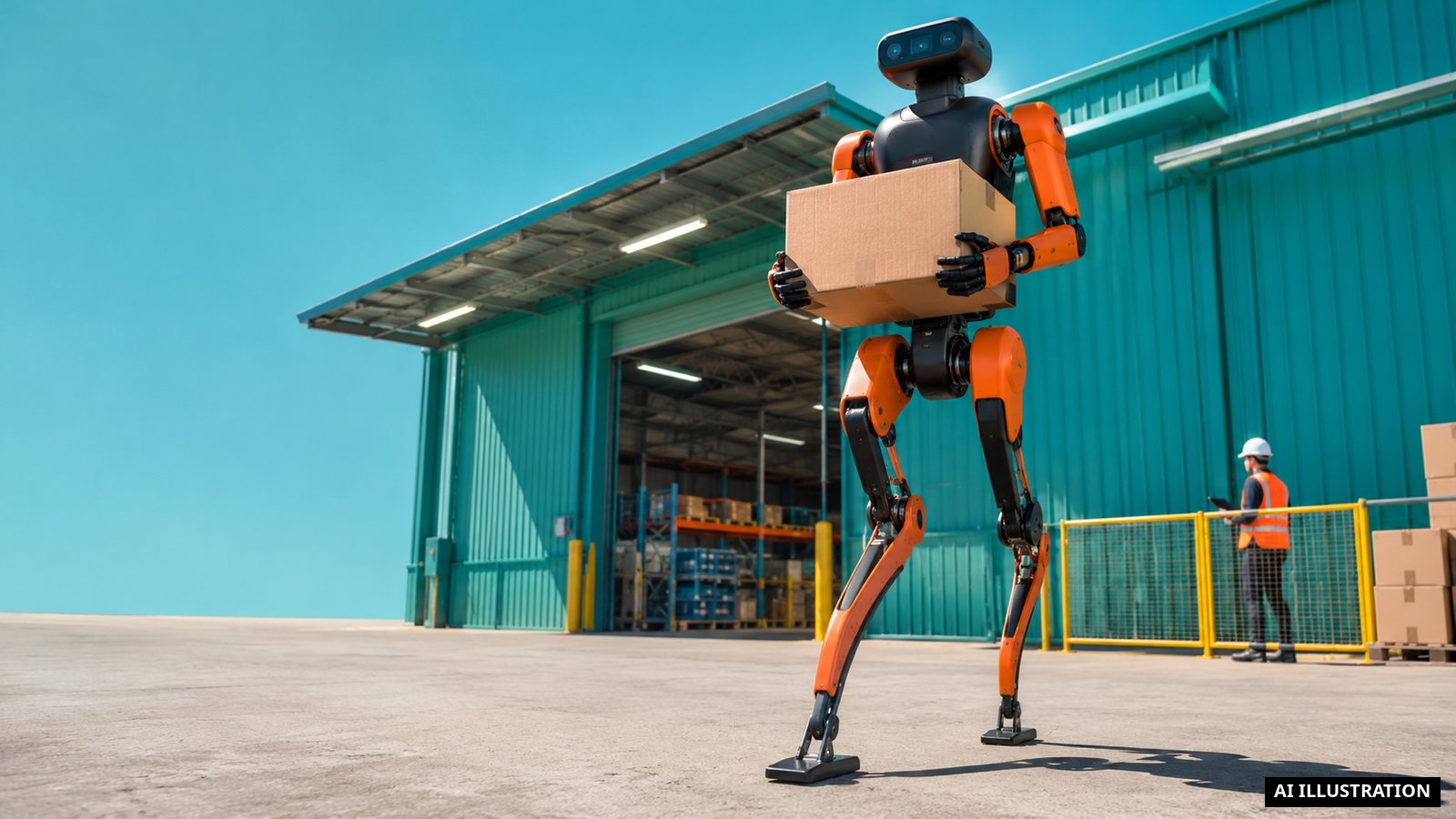
In one of its nine client facilities, a Digit moves between the packages, but a barrier still separates it from humans. It is there, behind this fencing, that the future of manual work is being decided. The humanoid robot from Agility Robotics is not science fiction. It is already there, in the warehouses of Amazon, Toyota and logistics company GXO (Business Insider). And tomorrow, it could be next to you.
The stock market bet on the logistics robot
Agility Robotics has become the first company purely specialising in humanoid robots to be listed on the Nasdaq in the United States (Business Insider, Investor’s Business Daily, semafor.com). To achieve this, the company completed its merger with Churchill Capital Corp XI, a special purpose acquisition company (SPAC) (Business Insider, Investor’s Business Daily, semafor.com). This deal valued Agility at approximately $2.5 billion (Business Insider, semafor.com). It is a strong signal sent to investors: the humanoid robot market is real, and it is ready to be monetised.
But behind the impressive figures, the financial reality is more nuanced. The company recorded revenue of $1.8 million last year, more than half of which came from the sale of five robots to one of its investors (Business Insider). Over the same period, it suffered a net loss of $138.1 million (Business Insider). The company used $99.8 million in cash to fund its operations in 2025 (Business Insider). According to Peggy Johnson, CEO of Agility, the market is difficult but the company is well capitalised (semafor.com). Investors, for their part, doubt that actual demand matches the enthusiasm for humanoid robots (semafor.com).
Agility Robotics' flagship product is a humanoid robot named Digit, which is similar to Tesla’s Optimus (Investor’s Business Daily). The latest model, the Digit 5, is designed to work in close proximity to humans and could be certified next year (semafor.com). But beware, humanoid robots currently cannot operate in factories without physical barriers because insurers do not cover them without third-party certification (semafor.com). It is this certification that is missing. It is this invisible barrier that still separates the robot from the human.
$300 million in orders, but a complex reality
Agility has over $300 million in orders for 1,000 robots from a single undisclosed client, with delivery scheduled for the first half of 2027 (Business Insider, semafor.com). It is a proof of trust, but also a risk. A single client represents the bulk of demand. If this client changes its mind, or if the technology does not keep up, the company is in danger. Agility’s Chief Robotics Officer wrote last month that the Digit 5 looks more like a forklift than a graceful humanoid and that he cannot like this model (semafor.com). The priorities are clear: functionality before aesthetics.
Competition is fierce. Agility Robotics' valuation is lower than that of its private competitors, notably Figure AI (approximately $39 billion), Apptronik (approximately $5.5 billion) and Neura Robotics (approximately $7 billion) (Business Insider). Internationally, the pressure is immense. According to Omdia, Chinese robotics companies accounted for approximately 90% of humanoid robot deliveries last year (Business Insider). The Chinese company Unitree, which was listed on the Shanghai stock exchange this summer, has a market capitalisation of approximately $40 billion (Business Insider). Unitree, a Chinese company, was listed in Shanghai in August and its value has since fallen (semafor.com). The market is volatile, but the race is on.
Meanwhile, geopolitics plays a crucial role. The Federal Communications Commission (FCC) banned new "advanced robotic devices" manufactured abroad in July, including humanoids (Business Insider). For American companies, this is an opportunity. For consumers, it is a question of availability and price.
And what if, tomorrow, it worked next to you?
Imagine your warehouse. The packages pile up. The mechanical arms rise. A Digit moves between the racks, precise, fast, tireless. It does not need a break. It has no back that aches. It does not complain. But it is there, two metres from you. The physical barrier is still in place, but it is coming down. The Digit 5 is designed to work in close proximity to humans (semafor.com). The insurers are waiting. The clients are waiting.
And what if, tomorrow, this barrier disappeared? What if the robot could hand you a box, help you load a truck, or simply watch over you to prevent an accident? This is not science fiction. It is the plan. The $300 million in orders is not a dream. It is a contract. The 1,000 robots are not prototypes. They are destined to be delivered in the first half of 2027 (Business Insider, semafor.com).
The question is no longer "if", but "when". When will the robot work next to you, without a barrier? When will the insurers cover it? When will the certification be obtained? In the meantime, the Digit remains behind the fencing. It is learning. And you, are you ready to work next to it?