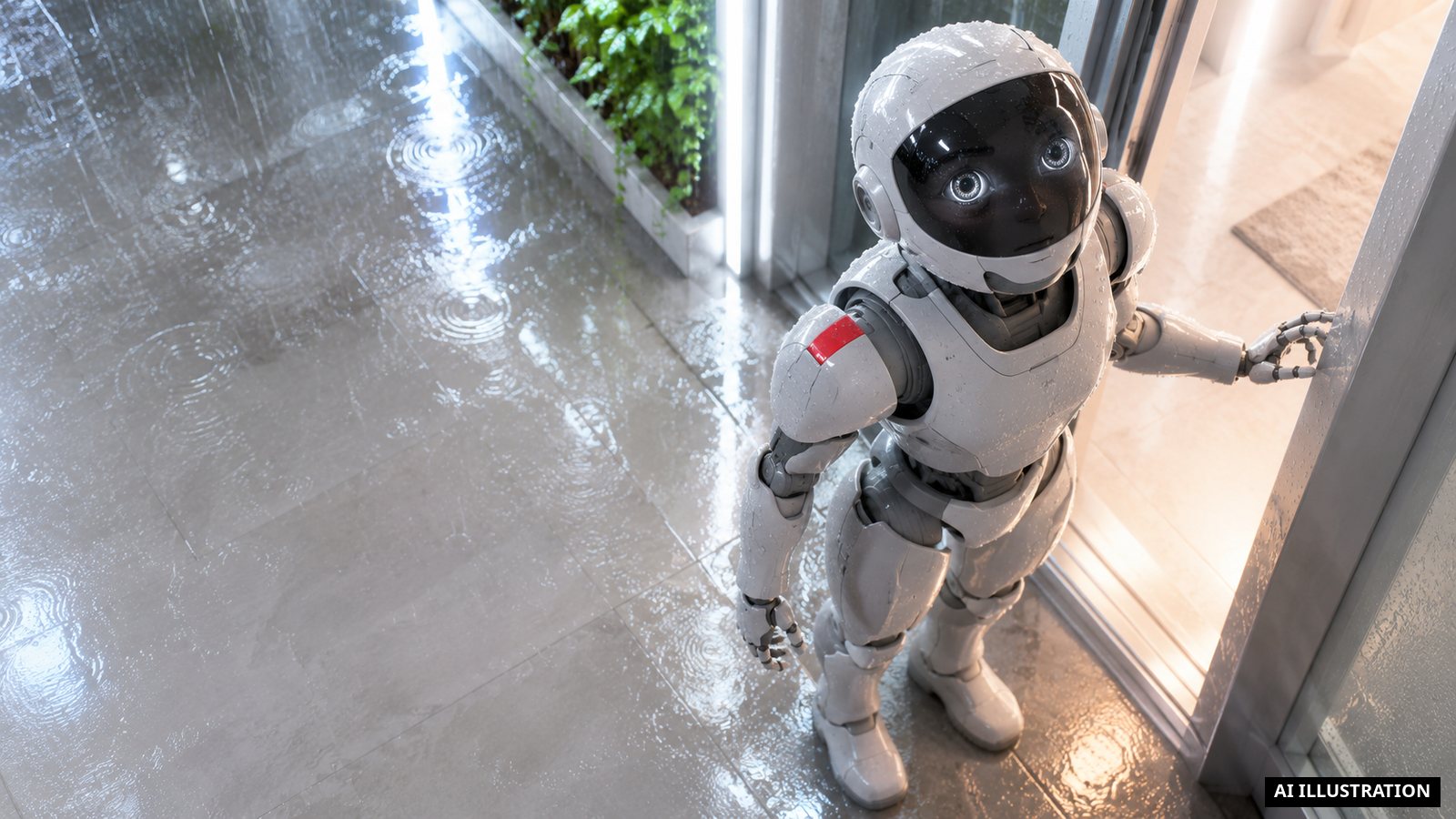
On the back of a Unitree G1, a 64 Go Mac mini M4 Pro, housed in a 3D-printed case, guides the robot through six real locations it had never mapped (ad-hoc-news.de). Just a machine that looks, calculates, and moves forward. That is where the thrill begins. It is no longer a remote-controlled toy.
On 4 November 2026, Apple’s research team published on arXiv an article titled “Perceptive Humanoid Motion from Simulation” presenting the autonomous control system HALO for humanoid robots, written by eight researchers (21jingji.com, BigGo Finance, ad-hoc-news.de, 快科技, 观点网). The HALO system was validated and deployed on the G1 humanoid robot by Unitree Robotics (BigGo Finance, ad-hoc-news.de, 快科技, 观点网). For now, it is a laboratory. But the walls of the laboratory are quickly disappearing. And what if tomorrow, this same intelligence found itself in your hallway?
Learning without seeing: virtual training
How does a robot know where the wall is if it has never been shown yours? The answer lies in a single figure: 1 000 procedural houses (ad-hoc-news.de, 快科技). The team used approximately 300 hours of synthetic episodes generated from these virtual structures for training, without human intervention (ad-hoc-news.de, 快科技). Imagine a parallel, infinite world where the robot stumbles, gets up, and learns to navigate around an imaginary piece of furniture, thousands of times. It does not see your sofa. It sees the concept of a “sofa”. It learns the physics of the object, not the object itself.
This is where the magic happens. When the robot enters a real, unknown, unpre-scanned location, it is not lost. It recognises shapes, distances, and constraints. It has already lived millions of virtual lives to be ready for yours. In six unknown real environments (not pre-scanned or mapped), the robot performed 360 simple task tests with an average success rate of 91% (21jingji.com, BigGo Finance, ad-hoc-news.de, 快科技, 观点网). Ninety-one percent. It is an autonomy that borders on human normality. No need to say “go there” anymore. It knows where “there” is.
The Achilles’ heel: chaining gestures
But reality is not a perfect labyrinth. It is chaotic. And that is where the dream hits the bone. For three composite tasks tested 10 times each in a real environment, the average success rate dropped to 70% (21jingji.com, BigGo Finance, ad-hoc-news.de, 快科技, 观点网). Why this drop? Because life is rarely a simple action. It is a sequence of actions. Bending down, walking, pushing. Each step is a chance to fail. And errors accumulate.
The specific task of bending down to pass an obstacle, walking towards a target, and pushing a box has a success rate of only 50% (快科技, 观点网). Fifty percent. It is the table corner waiting for you. It is the phone cable trailing on the floor. It is the moment when the robot hesitates, when its calculation diverges from physical reality. It knows how to push a box. It knows how to follow a person. But chaining them? That is where doubt sets in. And what if, tomorrow, it stumbles in front of your children? And what if, in your kitchen, it blocks the door because it misjudged the distance between the fridge and the wall?
The robot demonstrated abilities to push boxes, follow people, sit on chairs, and cross obstacles (观点网). These isolated skills are impressive. But life is the articulation of these skills. It is the fluid gesture. It is anticipation. And for now, anticipation remains fragile. The 70% for composite tasks is not a failure. It is a boundary. A red line that technology must cross to move from the laboratory to the living room.
Your home, its playground
Let us return to your home. To your couple. To your children. Imagine that this robot, with its Mac mini M4 Pro on its back, is there. It does not look at you. It looks at the floor. It calculates the trajectory. It knows you are there because it follows you. It knows the chair is there because it sits on it. But it does not yet know that the chair is fragile. It does not yet know that the floor is slippery after the vacuum cleaner has passed. It learns in the virtual. But the virtual has no texture. It has no noise. It has no life.
And what if, tomorrow, a robot learned in virtual houses to push a box, follow a person, and sit down without being shown your living room? That is already the case. But the “without being shown” hides a deeper truth: it does not know you. It does not know your habits. It does not know that you leave your keys on the table. It does not know that your cat sleeps on the sofa. It is a perfect stranger who perfectly masters space, but ignores the soul of the place. That is where the dream becomes unsettling. A perfect being in an imperfect world. A cold calculator in a warm home.
Apple has not yet put this robot in our homes. But the path is laid. 91% success in the unknown is the threshold of trust. 70% for complex tasks is the threshold of caution. And 50% for chaining is the threshold of fear. Tomorrow perhaps, you will see a silhouette moving in your hallway. It will not speak to you. It will not look at you. It will execute. And you will wonder: does it know what it is doing? Or is it improvising? The answer lies in the 300 hours of virtual training. But the question will remain in your head. And what if, tomorrow, it makes a mistake? And what if, tomorrow, it does not get up?