
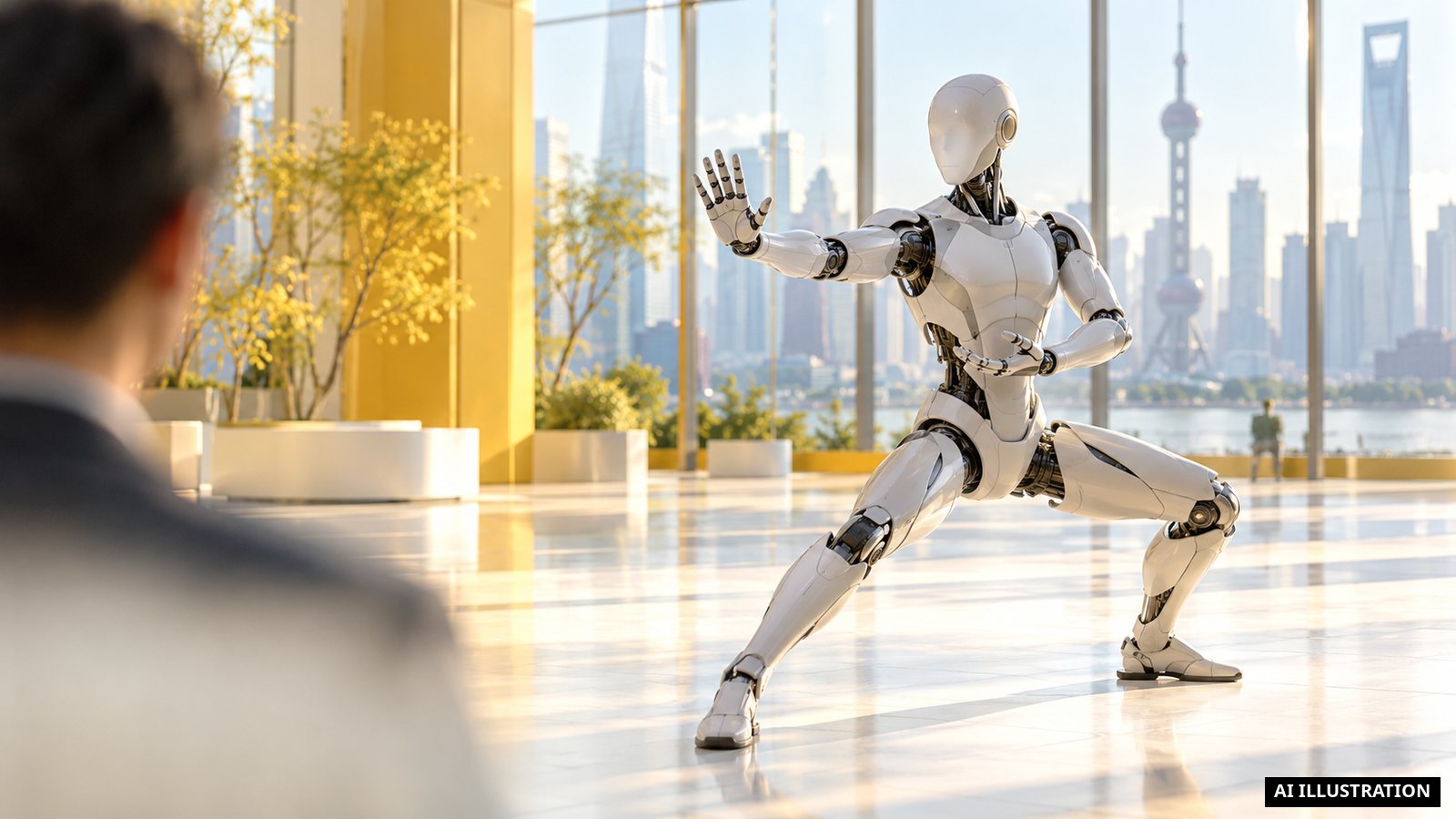
It has it all, or almost. The skills competition of the Global Developer Pioneers Summit (GDPS) 2025 in Shanghai presents itself as the first global skills competition in embodied intelligence, based on the criteria of the WorldSkills Competition, according to the Global Times. The setting is that of serious evaluation: six major tracks, seventeen specific events, according to Yicai Global. The jury, meanwhile, reportedly brought together for the first time experts in embodied AI, AI professionals and trade veterans from the WorldSkills Competition, to evaluate the consistency and reliability of robots in the manner of master craftsmen, reports City News Service.
On paper, the ambition is clear: to measure, compare and distinguish. Except that upon reading the reports, two hallmarks of a true competition are missing.
Not a single performance figure
The first absence, the most striking: no results. No scores, no rankings, no winner, no success or failure rate emerges from the reports. We know which events took place, we do not know who succeeded. The domestic services event, for example, required robots to fold laundry and put away dishes in a domestic environment, and the emergency rescue event imposed tasks on an extreme 10 by 30-metre track, again according to Yicai Global. How many robots actually completed their task? How many failed? The silence on this point is total.
A skills competition that publishes no quantified skills remains, by definition, a shell. We see the form of the evaluation, never its function.
When the organiser provides the critical equipment
The second absence, more discreet but decisive. According to the NCSTI, the organisers provided teams on site with dexterous robotic arms, advanced sensors and high-precision reducers. Yet, in a competition between builders, the equipment brought by each is part of what is being evaluated.
If critical hardware is shared, what each team brings of its own fades. The question becomes: what are we actually testing? The teams' software and AI, or common hardware that precisely erases the differences meant to distinguish the candidates? Lacking a published scoring system, it is impossible to decide.
The true register of the event: the stage
Where the event abounds in details is in its spectacle dimension. At the opening ceremony on 13 December 2025, the humanoid robot G1 by Unitree, dressed in a white Tai Chi outfit, performed Tai Chi movements alongside human martial artists, reports Yicai Global. The robot Yuanzheng A2 by AgiBot, for its part, played the drums to guide a dance group of Lingxi X2 units, according to DigiTimes. The same media notes that AgiBot (Zhiyuan) and Unitree took the stage together for the first time, their first joint humanoid performance.
This choreography is accompanied by structuring announcements: the launch of the construction of the Zhangjiang AI Innovation Town was announced at GDPS 2025, in parallel with this joint appearance, indicates Futu. In the background, Shanghai aims to bring the core of its embodied AI industry to more than 50 billion yuan by 2027, according to Yicai Global. In other words, a significant part of the event relates to marketing performance, not to the scored trial.
The demo as proof: a sectoral pattern
The unease becomes clearer when one relates this setup to the tools the sector itself promotes. Unitree’s developer platform would allow controlling humanoid robots remotely from a smartphone, using the phone’s camera to guide movements, and would offer pre-loaded action routines including martial arts, a The Twist dance and ballet sequences, reports Interesting Engineering.
In other words, the impressive gesture seen on stage can technically be teleoperated or pre-recorded. Nothing indicates that this is the case for the GDPS demonstrations — but it is precisely the absence of protocol and scores that makes it impossible to rule out.
Capturing the normaliser position
The real stake of GDPS is perhaps not to measure who knows best how to fold laundry. It is to capture a position: that of the normaliser. To have a standard for evaluating embodied AI homologated by the prestige of WorldSkills, one for which, for the moment, no one sees the figures. We certify a choreography, and we install ourselves as the actor who will define the rules of the game tomorrow. The form of the competition is there for that. The function, however, is still waiting for its results.