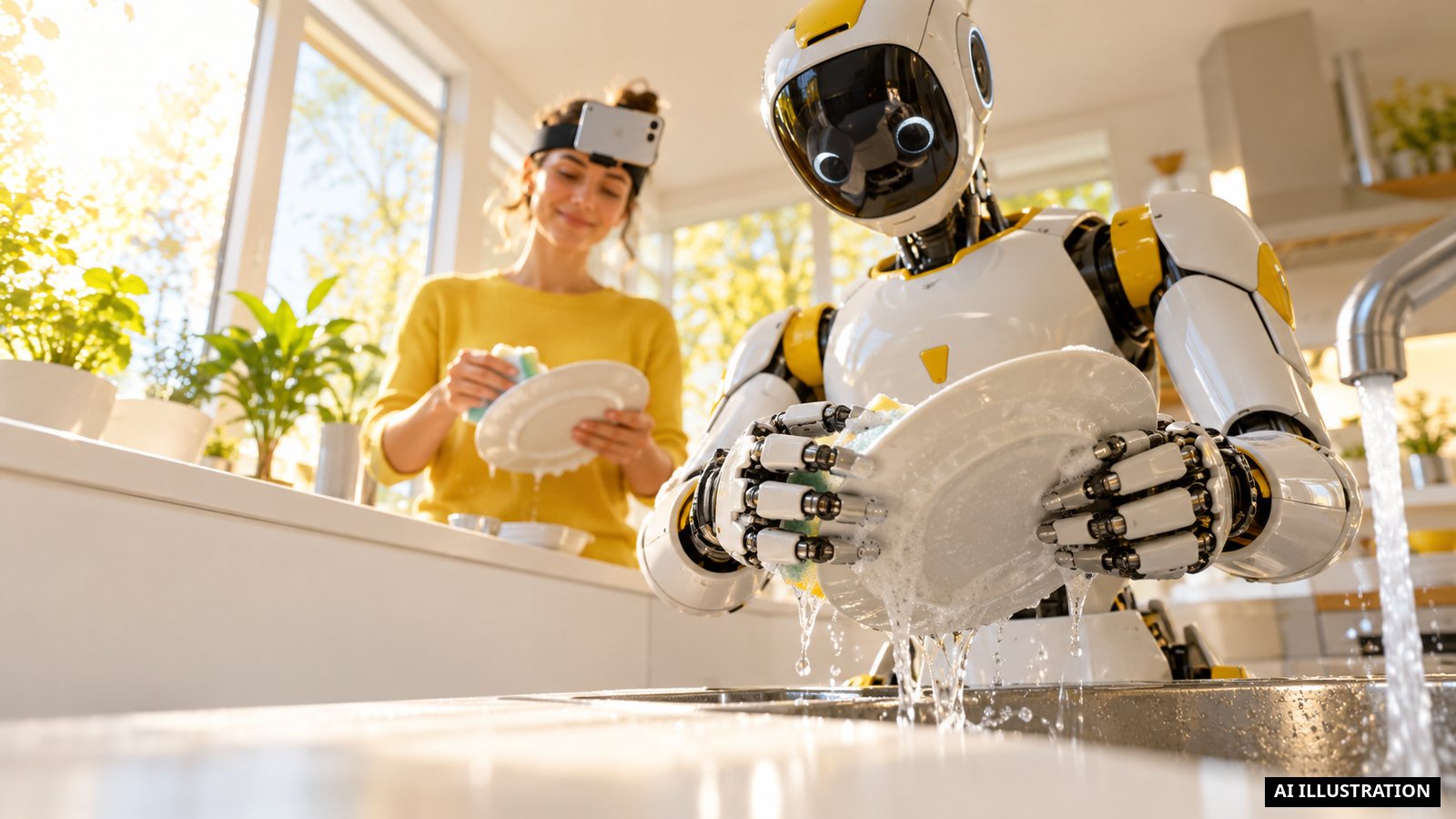
A phone on her head films her hands: she washes the dishes, folds the laundry, and she is paid for it. No hidden camera, no television game show. Just everyday life, captured in real time to feed an artificial intelligence. It is the opening scene of a new reality. Your kitchen, your living room, your most ordinary gestures suddenly become a precious raw material.
For decades, we have imagined robots as cold machines, assembled in sterile factories, capable of welding parts or carrying crates. We have seen them in science fiction films, gliding over smooth floors, executing industrial tasks with surgical precision. But for a humanoid robot to know how to hold a sponge, how to avoid spilling a cup, or how to fold a shirt without wrinkling it, it needs experience. It must be lived. It must be seen. It must be learned, gesture by gesture, by thousands of pairs of human hands.
Phone on the head, hands in the water: the job that pays
Imagine your morning routine. You brush your teeth. You put away your keys. You make your coffee. Now, imagine that you are wearing a phone fixed to your forehead. The lens points downwards, capturing your hands, your objects, your environment. This is what is called ‘egocentric data’ (20minutos). This technical term simply refers to what you see, from your own point of view. It is the robot’s perspective. For it to learn to act in the world, it must see the world as you see it.
In India, this practice has become an economic sector in its own right. Thousands of people are paid to film themselves doing housework in order to train AI robots (NPR). This is not an isolated anecdote. It is an industry that has emerged over the last year. Take the example of Sneha Jegadish, 24. She films herself for two to three hours a day doing the housework. In return, she earns approximately 120 dollars a month (NPR). The work is simple, but it requires consistency. You have to show the hands. You have to show the objects. You have to show the result.
The Indian company Objectways, in Karur, pays thousands of people to film themselves working (NPR). Rajeshkumar Ramaswamy, a senior employee at the company, states that data collection is not limited to India. The company collects data from people located all over the world, including in the Philippines and Nigeria (NPR). The diversity of hands, cultures, and environments is crucial. A robot learning to do the washing up in a kitchen in Bangalore must also know how to adapt to a kitchen in Manila or Lagos. Generalisation depends on the variety of data.
Objectways does not just collect videos sent in by individuals. The company also conducts in-house recordings in sets designed as apartments, with living rooms, kitchens, and bedrooms, to obtain higher-quality data (NPR). These data studios are laboratories of everyday life. This is where precision comes into play. The quality of the training depends on the quality of the observation.
From India to China: thousands of hands train the robot
In China, many freelance workers earn their living as ‘robot trainers’ by repeating housework tasks to generate data (vietnam.vn). They are not simply smartphone users.
The workers wear motion-tracking devices, such as sensor bracelets or microchips attached to their fingers, to record their gestures (vietnam.vn). This is a data granularity far superior to that of a simple video.
The monthly income of these robot trainers ranges from 4,000 to 6,000 yuan, which is approximately 15.5 to 23 million VND (vietnam.vn). It is a salary that allows one to live, but it demands considerable physical investment. Take Liu Yun, 40, who was made redundant from the automotive industry. She works in a data collection workshop in Beijing (vietnam.vn). For her, this new job has nothing to do with high technology. ‘Her work is more akin to raising a two-year-old child than to high-tech training,’ she reveals (vietnam.vn).
The production target in Liu Yun’s workshop is 160 samples per day, with performance levels that can exceed 260 for the best employees (vietnam.vn). Doing the washing up and wiping tables up to 200 times a day has put her physical endurance to the test, she admits (vietnam.vn). It is not a desk job. It is a job of hard labour. But each repeated gesture is a brick added to the robot’s brain. Each corrected error is a lesson learned.
Other workers, such as Sun, a 22-year-old student from Shanxi province, worked during their summer holidays folding clothes and recording standardised movements (vietnam.vn). He received a salary of 120 yuan (approximately 464,000 VND) for a quarter of a day and 135 yuan (approximately 522,000 VND) for a quarter of a night (vietnam.vn). For a student, it is an opportunity to earn money while contributing to innovation. But it is also a glimpse of the human effort required to create automation. The robot does not write itself. It is built, hand by hand, hour by hour.
Guo Hongquan, in Jiangsu province, earns approximately 4,000 yuan a month by performing household tidying tasks for six hours a day (vietnam.vn). His case is particular: he does not work in a workshop, but at home. He turns his own house into a data laboratory. He tidies, sorts, and organises, all while being filmed. It is the bridge between the professional world and the domestic world. It is a sign that the boundary between work and private life is disappearing. The robot learns in our homes. It learns from our homes.
What if the robot learned at your home?
Journalist Reece Rogers tested for a week platforms that pay for the recording of domestic tasks in order to train humanoid robots (20minutos). He tried three different companies: Kled, Luel, and Waffle Video (20minutos). His experience is revealing. After uploading nine videos and 97 photographs to the Kled platform, he received only one dollar (20minutos). The monetisation of data is not immediate. It is fragmented. It depends on quality, quantity, and the specific rules of each platform.
The Luel platform offers a rate of 6.60 dollars per hour of video, provided that the hands are visible in 95% of the images (20minutos). A five-minute video showing the washing up was initially rejected by Luel, before being accepted and paid 55 cents (20minutos). Rejection is frequent. Quality control algorithms are strict. If the hands disappear, if the image is blurry, if the gesture is ambiguous, the video is refused. You have to start again. You have to film better. It is an iterative process.
The Waffle Video platform pays 25 dollars per hour of video for tasks such as tying shoelaces or pouring liquids (20minutos). It is a higher rate, but the requirements are also more precise. Reece Rogers sent 125 approved recordings to Waffle Video in a few days, which earned him 20 dollars (20minutos). In total, the journalist earned 21.55 dollars in one week by combining the earnings from the three platforms (20minutos). It is not a fortune. But it is a signal. The market exists. The demand is real. Companies are willing to pay to access human reality.
What if, tomorrow, you had to film yourself to train the robot that will do your washing up? What if your phone became your main work tool? What if your kitchen became a data production site? Rajeshkumar Ramaswamy believes that, at the current pace, domestic robots could be commercialised in India in the coming years (NPR). It is no longer a question of ‘if’, but of ‘when’. The technology is there. The data is there. The hands are there. All that is missing is the final product.
Sneha Jegadish hopes that a robot will take over housework, even if it means she loses her current job (NPR). This is the paradox of this new economy. We are creating the tools that will replace us. We film ourselves to teach the machine what we know how to do. We sell our time to finance our own obsolescence. But is that so bad? If the robot takes over repetitive, tiring, and arduous tasks, do we not gain time? Do we not gain freedom?
The robot is not an enemy. It is a student. And we are its teachers. Each gesture you film, each movement you capture, is a lesson. You teach it to hold a fork. You teach it to open a tap. You teach it to avoid obstacles. You teach it to live. And in return, it will give you back your time. It will give you back your energy. It will give you back your life.
So, next time you wash a plate, look at your hands. Look at the water running. Look at the foam forming. Imagine that you are writing the source code of a future companion. Imagine that your routine is the basis of its personality. The robot is not in a factory. It is in your kitchen. It is in your living room. It is in your hands. And it is learning, day after day, to become like you. To become useful. To become indispensable.
The question is no longer whether the robot will do your washing up. The question is whether you are ready to show it how. Do you accept becoming the machine’s teacher? Do you accept that your daily life is the raw material of innovation? In a few years, when you see a humanoid robot gliding into your kitchen, clean and efficient, you will know where it comes from. It comes from your hands. It comes from your gestures. It comes from you.