
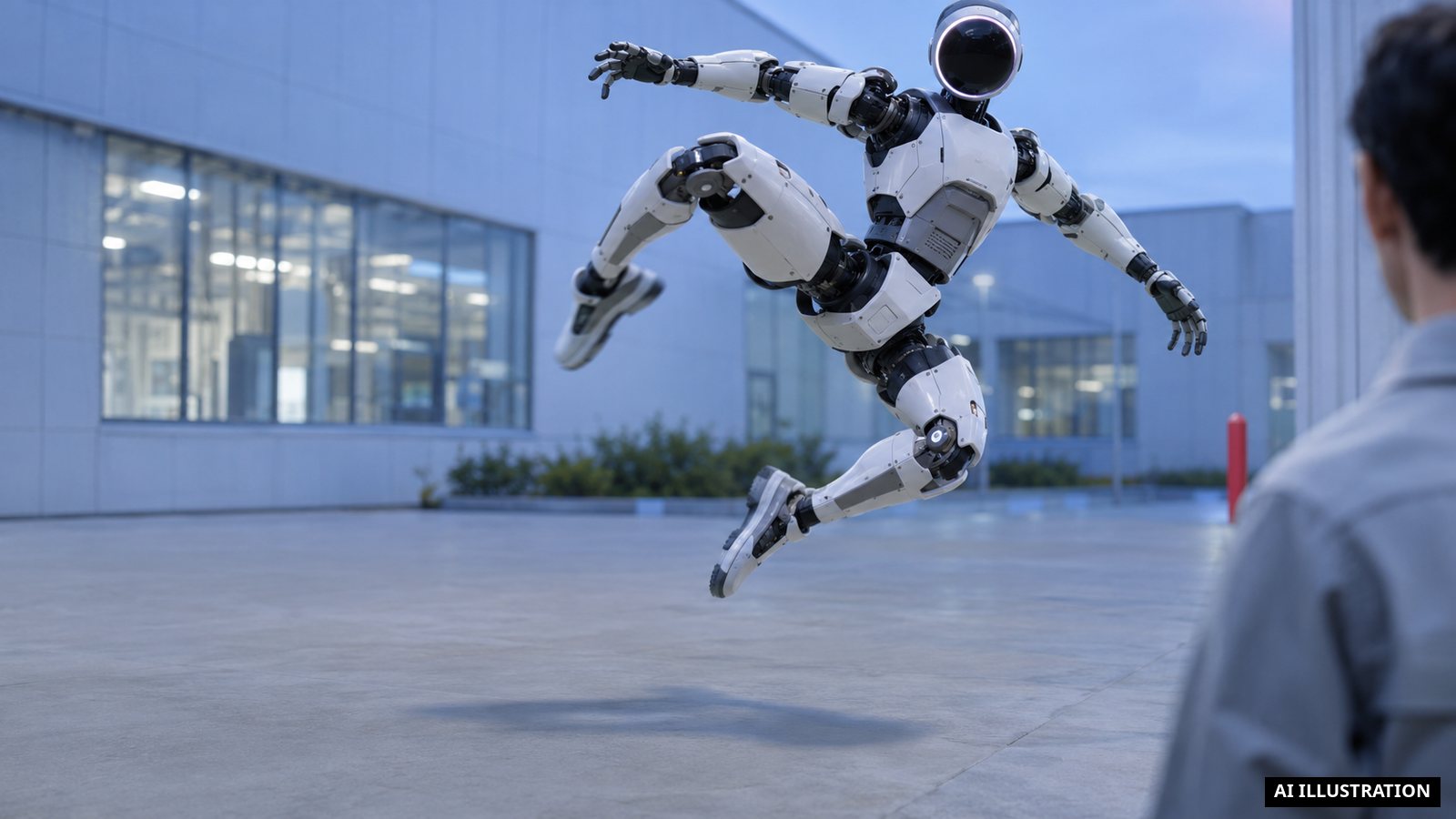
In a video published by Boston Dynamics, the robot Atlas no longer has feet. It has wheels. And it jumps. Not a small, cautious hop, but a full 360-degree rotation in the air, before landing with surgical precision. (Boston Dynamics)
You watch the screen, you hold your breath. The robot spins, the world whirls, then silence. It is there, stable, on a single wheel. No fall. No wobble. Just total mastery of its balance. It is the kind of image that stays in your mind when you head home, wondering if this metal will ever cross your path.
The jump that made the buzz: 360 degrees, a single wheel
It is not an accident. It is not video manipulation. It is a complex manoeuvre, successfully executed on the first attempt. (Boston Dynamics)
How? By following a recorded trajectory, derived from human motion capture. The robot learned to imitate the movement, to reproduce it, to perfect it. But it is not just about copying. It is about understanding the physics of movement. (Boston Dynamics)
Atlas had to learn to roll during lateral dodges. Where a human would slide their feet to avoid an obstacle, the robot uses its wheels. It adjusts its full body movement while the contact conditions with the ground are constantly changing. (Boston Dynamics)
The result is stunning. The robot can move quickly, change direction freely, and maintain its balance on a single wheel. (Boston Dynamics)
Why a wheel? Why not feet?
The answer is technical, but it has concrete implications. The addition of a single custom adapter was enough to mount a scooter rim on the existing ankle actuator. (Boston Dynamics)
Simple? No. Effective? Yes. This conversion shows that flexibility is the key. A robot that can switch from a bipedal mode to a wheeled mode is a robot that adapts. And adaptation is what we expect of a colleague.
What if the robot in your factory knew how to dodge?
Imagine your workshop. The machines are running, the conveyors are moving, the operators are moving around. And if, tomorrow, a robot like Atlas were moving among you?
It would not walk slowly. It would roll. It would dodge. It would pivot. (Boston Dynamics)
The motors of this robot must withstand real loads during start-up, turning, and stopping, while constantly delivering high torque and speed. (CHOSUNBIZ)
This is not a demo. It is performance. The wheeled version of Atlas is intended for research, serving as a test bench to validate the performance of propulsion units and full body control, including in extreme conditions. (Boston Dynamics)
“Extreme conditions” is the keyword. Not a smooth and perfect floor. Not a constant temperature. Real, unpredictable, harsh environments. (Boston Dynamics)
The team used a sim-to-real process. The robot was trained on millions of simulations, using the MuJoCo physics engine, to reduce the gap between the virtual and the real. (Boston Dynamics)
Millions of times, the robot fell, got up, adjusted its posture, learned. Until the movement was perfect. Until the 360-degree jump became natural. (Boston Dynamics)
And the insights from this project are already being adapted to the standard configuration of the Atlas robot. (Boston Dynamics)
This means that what you see in the video is not an isolated prototype. It is an evolution. A step. A step towards something bigger.
Does that reassure you? Or does it scare you?
If you work in a factory, you know that safety is paramount. A robot that jumps, that pivots, that rolls fast… It is fascinating. But it is also a variable. A variable that changes the dynamics of the workspace.
A robot that dodges is a robot that avoids collisions. It is a robot that protects. But it is also a robot that occupies space. That imposes its presence. That forces humans to adapt to it, and not the other way around.
The question is no longer “can it do it?”. The question is “how will it do it with us?”.
Why it is not yet the robot of your factory
Do not get your hopes up. This robot is not for sale. (Boston Dynamics)
The wheeled version of Atlas is a research tool. A test bench. (Boston Dynamics)
It serves to validate technologies. Performance. Limits. (Boston Dynamics)
The motors must hold the load. The body control must be perfect. The balance must be absolute. (CHOSUNBIZ)
All of this takes time. Years, perhaps. Decades, perhaps.
But every jump, every rotation, every landing on a single wheel brings the day closer when these technologies will be ready for the real world. (Boston Dynamics)
The robot in your factory may never jump 360 degrees. But it will know how to dodge. It will know how to roll. It will know how to adapt. (Boston Dynamics)
And when it does, will you be prepared?
Technology advances. Life, on the other hand, continues. But the boundary between the two is becoming increasingly thin. (Boston Dynamics)
Watch the video one more time. The robot jumps. It spins. It lands. And it stays there, motionless, waiting for the next instruction.
And you? What are you waiting for?