
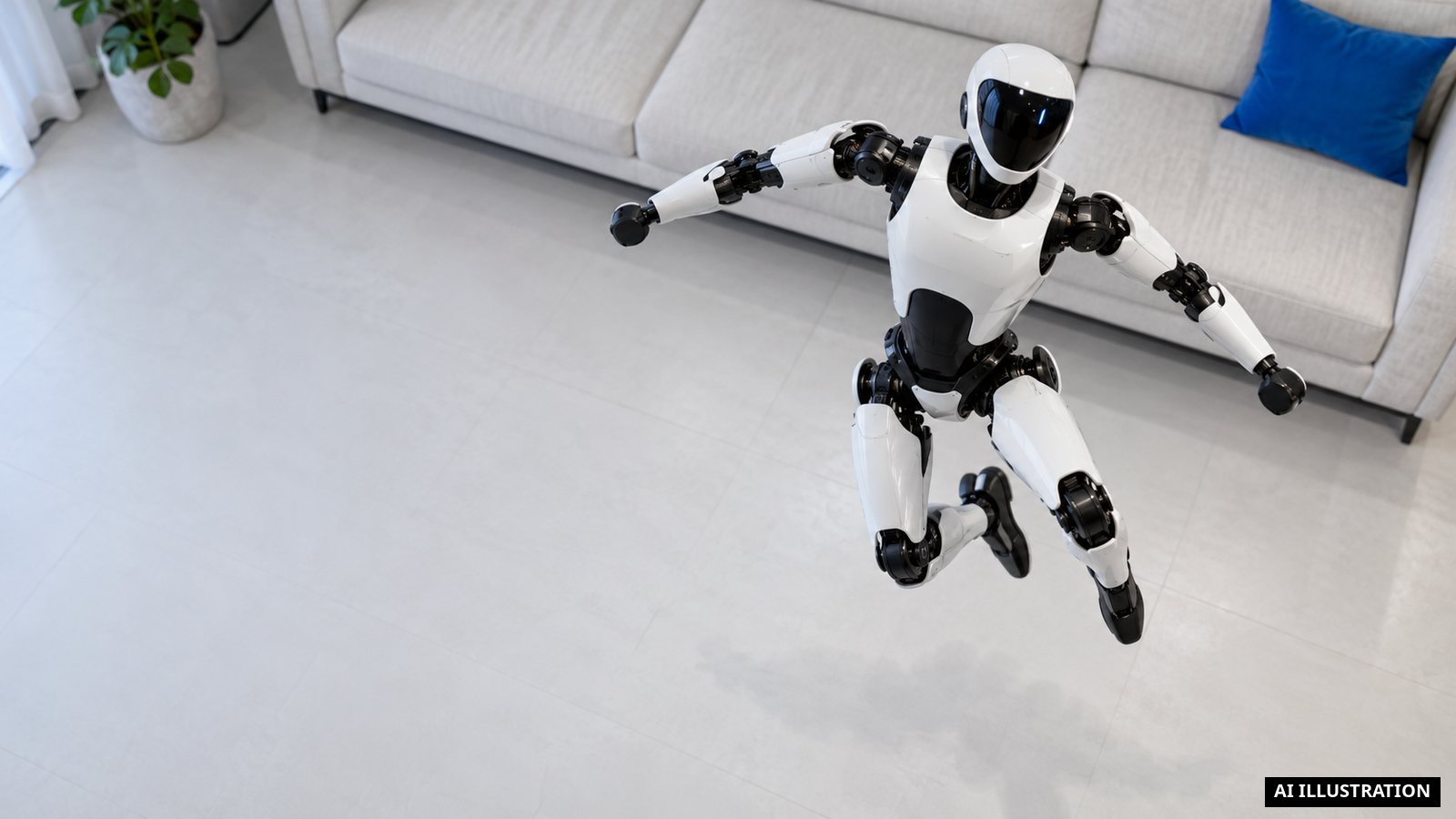
Before the screen of Joybuy’s French shop, three metallic silhouettes stare at you. The R1 Air and the R1 are listed at less than 6,000 euros. The G1, more imposing, costs approximately 18,000 euros (LaboMaison). That is the price of a corner sofa, or two good holidays. But it is not a piece of furniture. It is a machine that moves.
The dream: an acrobat for less than €6,000
The R1 stands approximately 1.23 metres tall. It weighs 29 kg (LaboMaison). Not a colossus, but a presence. It features 26 joints. Except that is not the essence. The essence is movement. The R1 and the R1 Air are locomotion robots. They walk. They jump. They perform somersaults (LaboMaison).
Imagine the scene. You come home from work. The R1 is there. It does not wait. It jumps. A backflip, fluid, precise. Your child, if you have one, freezes. The robot does not fall. It lands. It is stable. For less than 6,000 euros, you have an acrobat in your living room. The R1 Air, meanwhile, weighs 27 kg and has 20 joints, but it shares this ability to defy gravity (LaboMaison). It is the technological dream made accessible. The entry barrier has fallen. You can almost touch it.
The fear: stone fists and one hour of life
But the dream collides with physical reality. The R1 has fixed fists (LaboMaison). No fingers. No palm. Just rigid blocks. It cannot grasp. It cannot hand you a cup of coffee. It cannot pick up the toy lying on the floor. It cannot open a door. It jumps, yes. But it manipulates nothing. It is a dancer without hands.
And then, there is time. The announced autonomy of the R1 and R1 Air is approximately one hour (LaboMaison). One hour. That is the length of a TV series episode. During this time, it is inert. A 29 kg block that merely decorates your room. Without these hands, the G1 remains a spectator. With them, it becomes an actor.
The lighter R1 Air does not change the game. It has fewer joints. But it has the same fundamental problem. It does not grasp. It does not programme. It executes. And it stops when the battery is empty. It is a guest who stays only long enough for a coffee. And even then, it cannot hold it.
The question: who programmes your living room?
The most worrying aspect is not the price. It is the software silence. No SDK or API is available for the standard models of these robots (LaboMaison). No free access to sensors. No customisation. You cannot tell the R1: "When I say 'hello', jump". You cannot ask it to avoid the cat. You cannot teach it to pick up the remote control. It is closed. It is a finished product, frozen in its code.
Who decides what it does? The company. Who decides what it sees? The company. Who decides what it jumps? The company. You buy a body, but not the mind. You buy locomotion, but not adaptive intelligence. It is like buying a car without a steering wheel, without a dashboard, without GPS. It rolls. It jumps. But you do not know where it is going. And you cannot reprogramme it to avoid the neighbour’s dog.
The G1 is indicated as available, while the R1s are on pre-order with delivery scheduled from 1 October (LaboMaison). Time is pressing. Or rather, time is passing. They will jump. They will recharge. They will remain there, silent, fixed, useless for everything that matters in daily life. The dream of an intelligent companion collapses before the reality of a motorised toy.
And if tomorrow, an SDK were released? And if hands became standard? And if autonomy doubled? Would the price remain the same? The R1, at less than 6,000 euros, is a half-open door. But behind it, there is no friend. The question is no longer "can it enter your home?". The question is: "what is it doing there?"