
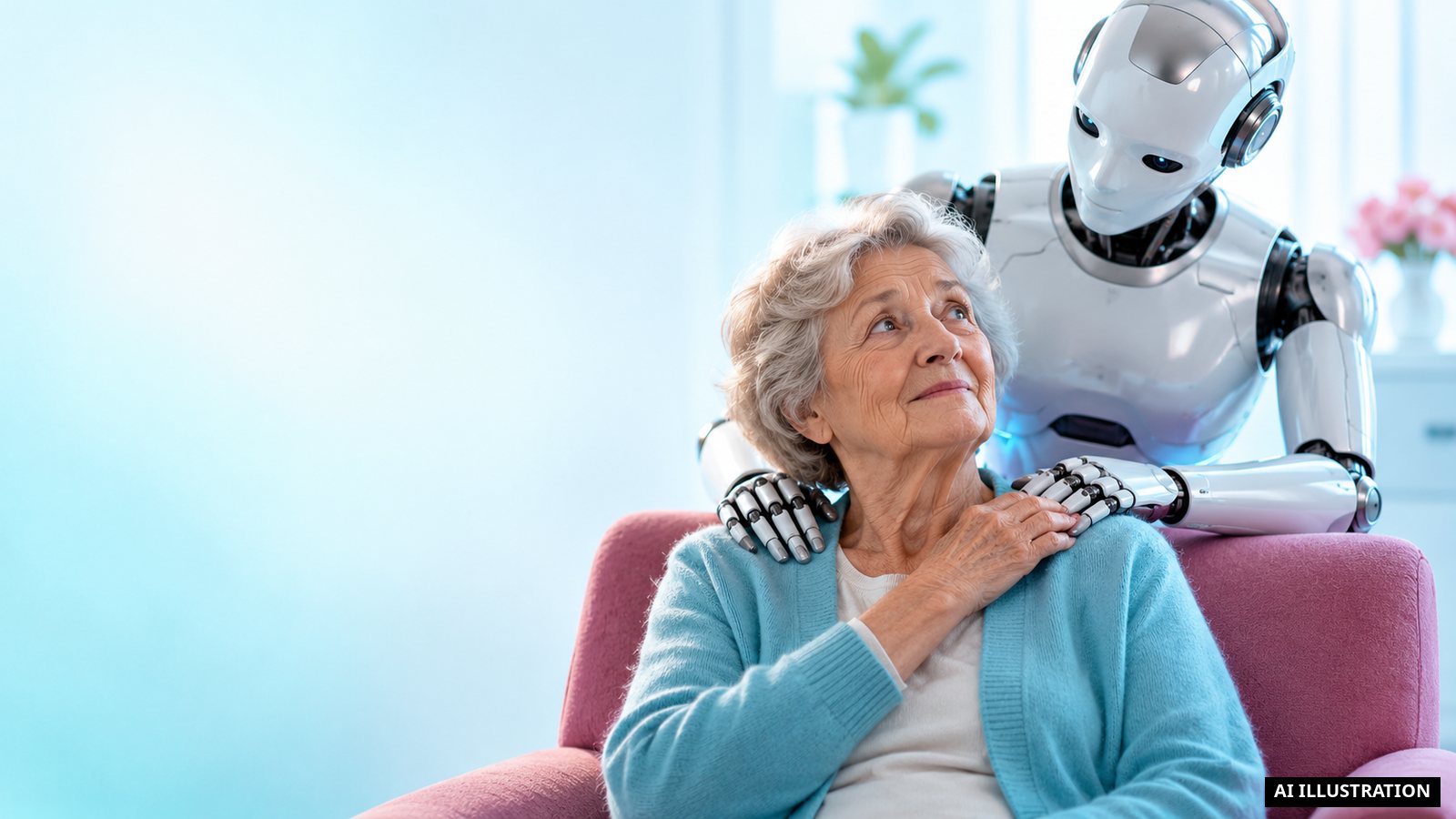
The silence of the room is broken by the soft hum of a motor. A mechanical arm, articulated with unsettling fluidity, moves towards the shoulders. This is not an optical illusion nor a science-fiction film. This scene is taking place in Beijing, at an intelligent robotic care facility presented as the ‘first in the world’ (DW). Humanoid robots are being tested there to massage and monitor the health of the elderly (DW). The gesture is gentle. The technology, however, is cold. And yet, for many, it is the only hope that remains.
Does the robot that massages mum already exist?
In China, demographic reality weighs heavily on the shoulders of families. The country has approximately 320 million elderly people (ZDFheute, DW). Faced with this colossal figure, a persistent shortage of qualified carers has set in (DW). Families are exhausted. It is into this void that robotics and artificial intelligence are considered key technologies to meet the growing demand for care (DW).
In Beijing, visitors observe these machines. Some feel uncomfortable in the presence of these beings that resemble humans (DW). The gaze is dull, the movement repetitive. But for a daughter working at the other end of the city, or a son who cannot get away, this robot represents a presence. It does not judge. It massages. It monitors. According to care experts, robots cannot yet replace human care and attention (ZDFheute, DW). But they can provide relief.
The care robot is not an exception. What if, tomorrow, your mother had an assistant that checks her blood pressure, reminds her to take her medication, and gives her a back massage after dinner? The fear of intrusion is mixed with gratitude. It is this complex mixture that defines this new era.
In Germany, will robots go into homes?
While China tests robots with the elderly, Germany keeps them for the factory. But the boundary is blurring. Germany ranks 5th in the world and 1st in Europe in the field of robotics, both as a developer and as a client (ZDFheute). Here, the logic is industrial. Labour is in short supply. Humanoid robots are seen as the solution.
BMW is testing humanoid robots in its Leipzig factory, where they are tasked with transporting heavy battery modules in an advanced phase of testing (ZDFheute). These machines do not massage. They lift. They transport. According to a Bitkom survey, 6% of German industrial companies currently use humanoid robots and a further 10% plan their deployment (ZDFheute). It is not yet the mass. But it is the signal.
The numbers are rising. According to Ulrich Stephan, head of private investment strategy at Deutsche Bank, global deliveries of humanoid robots could reach approximately 20,000 units in 2025, more than one million by the end of the decade, and more than ten million in the middle of the following decade (ZDFheute). China supplies more than 90% of humanoid robots worldwide (ZDFheute). Germany buys. Germany tests. Germany integrates.
Companies see a productive future. According to Marlene Kionka of Bitkom, 58% of industrial companies consider humanoid robots a solution to the shortage of skilled labour and 68% expect a reduction in workplace accidents (ZDFheute). According to another part of the survey, 64% of companies expect humanoid robots to make industry more productive (ZDFheute). But the time to adoption is long. Many companies believe that humanoid robot technology will not become widespread until at least ten years from now, and more than 50% predict it in 11 to 20 years (ZDFheute).
What if the robot never replaces the human?
There is a line that is not crossed. Or at least, not yet. The robots in Beijing massage. The robots in Leipzig transport. But none comfort. None understand the pain of loss. Experts say it: human attention remains irreplaceable (ZDFheute, DW). The robot is a tool. A very advanced, very precise, very available tool. But a tool.
Imagine the scene. Your mother is alone. The robot enters the room. It adjusts the light. It checks her pulse. It offers her a massage. She closes her eyes. She does not see the machine. She feels the movement. Does that matter? Does the gesture matter more than the intention? For the 320 million elderly people in China, the answer could be yes. For French families, the question remains open.
China tests. Germany industrialises. The world observes. Humanoid robots are no longer a distant promise. They are here. In the factories. In the care centres. And soon, perhaps, in the homes. Their arms are cold. But their presence, it is warm. And what if, tomorrow, it was your turn to choose?