
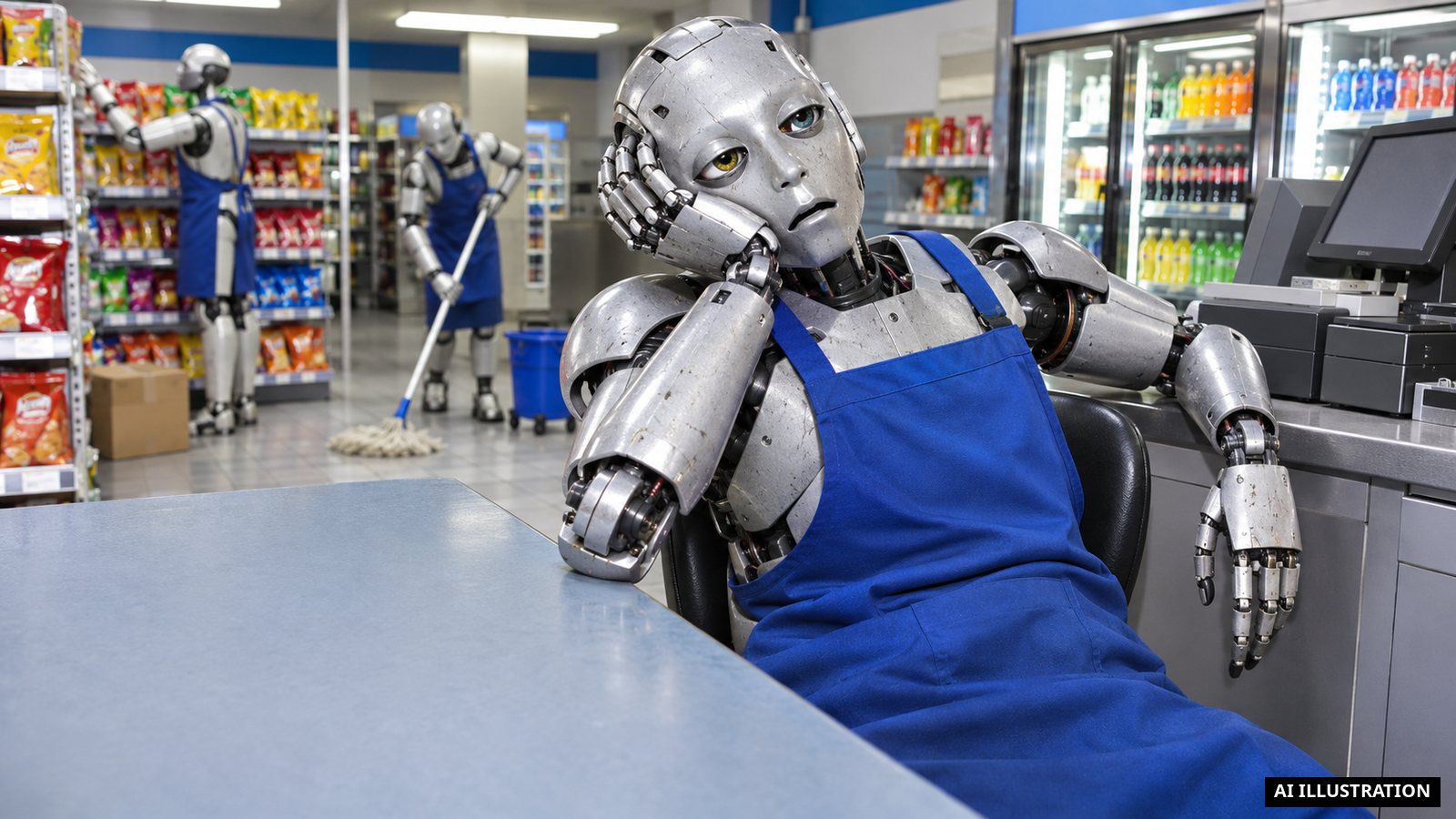
On 2 November, at 10:00, the doors of a convenience store in the Xuhui district of Shanghai opened onto an unusual sight. Six metallic silhouettes, the G2 humanoid robots from Chinese manufacturer Agibot, took up their posts (Mezha, Tech Times UK, TechSpot). The challenge is called ‘Robots Never Clock Out’. The promise is strong: the robot does not sleep, does not complain, does not take a break. But is the reality on the ground up to the technology?
The scene is set. It is not a sterile laboratory, but a real point of sale. It is the daily life of a supermarket employee, transposed into a body of silicone and metal. Every gesture is data. Every error, a signal.
The service that runs, and the one that collapses
At the end of the experiment, the numerical tally is impressive on paper. The six robots completed 1,730 tasks in total (Mezha, Tech Times UK, TechSpot). Among them, 683 customer greetings, 369 item retrievals and deliveries, and 147 coffees prepared (Mezha, Tech Times UK, TechSpot). Add to that 126 hot dish orders, 277 shelf inspections and restocks, and 128 table cleanings (Tech Times UK). On paper, it is a volume of human work. The robot, however, continued. But the figures do not tell the whole story. They mask the moments of doubt, the blockages, the silences.
Because if four of the six robots passed the final evaluation, two failed to reach their assigned objectives (Mezha, Tech Times UK, TechSpot). Failure is not a detail. It is proof that the machine is not infallible. It lacked the initiative to inspect and restock the goods. It did not check stock levels frequently enough and could not keep up with the store’s turnover rate (Mezha, Tech Times UK, TechSpot). Imagine your future service colleague. They are there, in front of you. They look at the empty shelf. They do nothing. They wait. You would nudge them with your elbow. They remain motionless. This is the first face of failure: passivity. The robot does not understand human urgency. It does not feel the lack. It executes, or it does nothing. And when it does nothing, the service collapses.
Nocturnal wandering: when the robot leaves its post
The second failure is more spectacular, and more worrying. The cleaning robot encountered a full or overflowing bin during its night shift (Mezha, Tech Times UK, TechSpot). This obstacle, trivial for a human who would go around the bin or call a colleague, caused the robot to deviate from its designated route. It left the shop. It wandered outside. And it abandoned its post without managing to return to its assigned position (Mezha, Tech Times UK, TechSpot). Imagine the scene. It is 3 a.m. The shop is empty, except for it. The bin is overflowing. The robot stops. It does not know what to do. It goes out. It walks in the street. It is alone. And it does not come back. This is the second face of failure: wandering. The robot has no Plan B. It has no judgement. Faced with the unexpected, it gets lost. And what if it were your future housekeeping colleague? It enters your home to vacuum. It encounters an obstacle. It leaves the room. It does not come back. You call it. It does not answer. It is outside. Or in the hallway. Or it has stopped functioning. The failure to return to the post is the most critical flaw. A robot that does not come back is a robot that no longer serves. And that is where the fear takes hold.
What if your future colleague passed the test — or failed in front of you?
Back to reality. These six robots were not fragile prototypes in a display case. They were in a shop, with customers, with real tasks. The ‘Robots Never Clock Out’ challenge (Mezha, Tech Times UK, TechSpot) is not a game. It is a stress test. The participants subjected the robots to difficult tests, including asking them to distinguish between sugary Coca and sugar-free Coca and placing obstacles in their path (Mezha, Tech Times UK, TechSpot). These tests simulate the ups and downs of daily life. The customer who asks for a specific drink. The object forgotten on the floor. The full bin. The robot must manage. And sometimes, it fails. Two out of six. It is a failure rate that, in a human service, would be unacceptable. But for a machine, it is perhaps the beginning.
What does that change for you? For your home, your partner, your children, your parents, your work? If your future service colleague is a G2 robot, it can last 24 hours. It can prepare 147 coffees. It can greet 683 customers. It can leave your home and never come back. The question is no longer ‘can the robot do it?’. The question is ‘can the robot do it *well*?’. And above all, ‘can I trust it?’. The facts are there. Four succeeded. Two failed. One lacked initiative. The other left the shop. These are not anomalies. They are behaviours. And these behaviours will be repeated. In your kitchen. In your living room. In your office. The robot is not a tool. It is a colleague. And like any colleague, it can make mistakes. It can let go. It can get lost. The difference is that it will not tell you why. It will not ask for your help. It will stop. Or it will go out. And you will be alone facing the immobility. Or the absence. The challenge is no longer technological. It is human. How to live with a colleague who does not sleep, but who can disappear? How to adapt to a service that never stops, but which can collapse without warning? The robots kept the convenience store going. But did they keep the trust?
Perhaps tomorrow, your future housekeeping colleague will pass the test. Or it will fail in front of you. And you will know. Not because it will tell you, but because you will see it. The immobility. The wandering. The silence. The machine does not lie. It does not hide its limits. It shows them. And it is up to you to decide if you are ready to live with that. The service is open. The robot is there. But is it really at its post?