
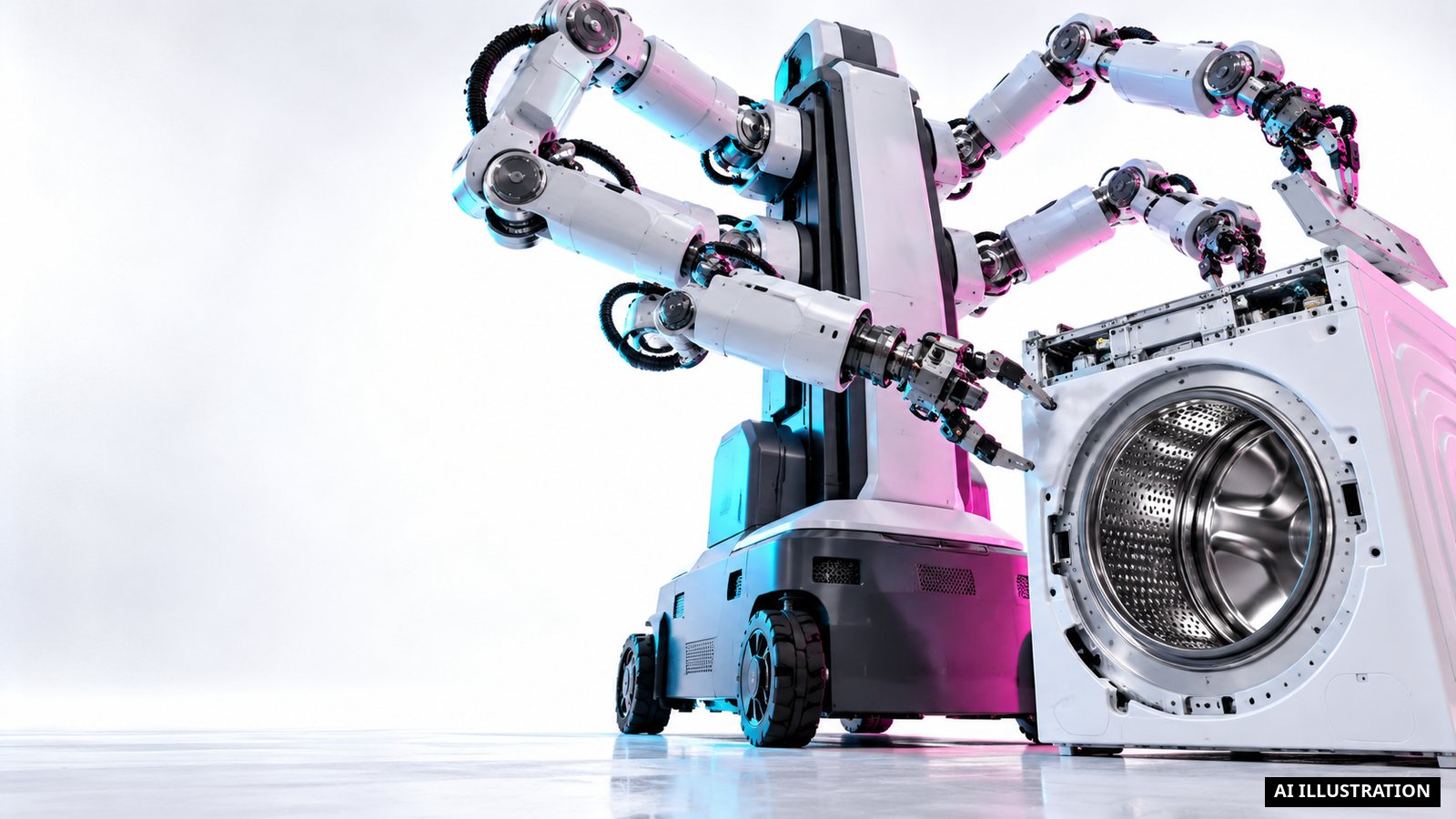
On 5 December 2025, at the Greater Bay Area New Economy Forum, the Chinese group Midea presented a robot named MIRO U, which it describes as a humanoid robot, according to the media outlet Interesting Engineering. The headline accompanying the machine is catchy: six arms. But on closer inspection, this robot mostly tells a different story, that of a word, humanoid, which no longer means much.
Six arms, but no legs
Let us start with the form, as it is what intrigues. According to Interesting Engineering, MIRO U has a humanoid-type head and torso, but it does not walk: it moves on a wheeled chassis, not on legs. And it does not have two arms like us, but six fully motorised bionic limbs (i.e. articulated arms controlled by motors), capable of performing three tasks at the same time.
To summarise. A humanoid, in the literal sense of the word, is a machine that imitates the human body: two legs, two arms, a head. MIRO U, however, has a head and a bust, but rolls instead of walking and carries three pairs of arms. In other words, on the two points that truly define our anatomy, the number of arms and walking on two legs, it takes the opposite approach. We have a mobile machine-tool to which a head and a torso have been added to make it look like someone.
Why this shape, precisely?
And this is where the choice becomes interesting, because it is logical. If a machine must do three things at once on an assembly line, six arms are better than two. If it must move on a flat, smooth factory floor, wheels are simpler, more stable and less expensive than legs. The shape of MIRO U is therefore not a failed humanoid: it is the admission, by engineering itself, that the human silhouette is not the best for the work targeted.
Then there remains a simple question: why continue to call it a humanoid? The answer probably has less to do with technology than with communication. Humanoid has become a selling label, detached from anatomy. A head and a bust are stuck on an industrial robot, and the magic word does the rest.
A washing machine manufacturer making its own robot
The other surprise lies elsewhere. Midea is not a specialist in humanoid robotics: it is, fundamentally, a home appliance giant, a manufacturer of washing machines and air conditioners. Yet, according to Interesting Engineering, MIRO U is due to enter a testing phase in Midea’s own high-end washing machine factory, in Wuxi, by the end of December 2025.
This detail says a lot. Rather than buying a robot from a specialised company, Midea builds its own, for its own lines. In plain terms, the manufacturer internalises robotics instead of outsourcing it. This is what is called vertical integration: doing in-house, internally, what could be ordered externally. To put it simply: it is like a baker deciding to make their own oven, to measure, rather than buying one off the shelf.
And the famous 30 per cent gain?
It is also credited with quantified promises. Still according to Interesting Engineering, MIRO U should bring approximately 30 per cent more efficiency during production changes, those moments when a line must switch from one model to another and every minute counts. The figure is announced before the tests, and comes from a single source: it must therefore be taken as an estimate by the manufacturer, to be verified in real conditions, not as an already measured result.
Ultimately, MIRO U is less the world’s first six-armed robot than a good illustration of a drift: the word humanoid now serves as a marketing label, even when the machine rolls and carries three pairs of arms. The real news is not in the superlative, but in what it hides: a shape dictated by the task rather than by our silhouette, and a home appliance industrialist making, all on its own, its own factory robots.