
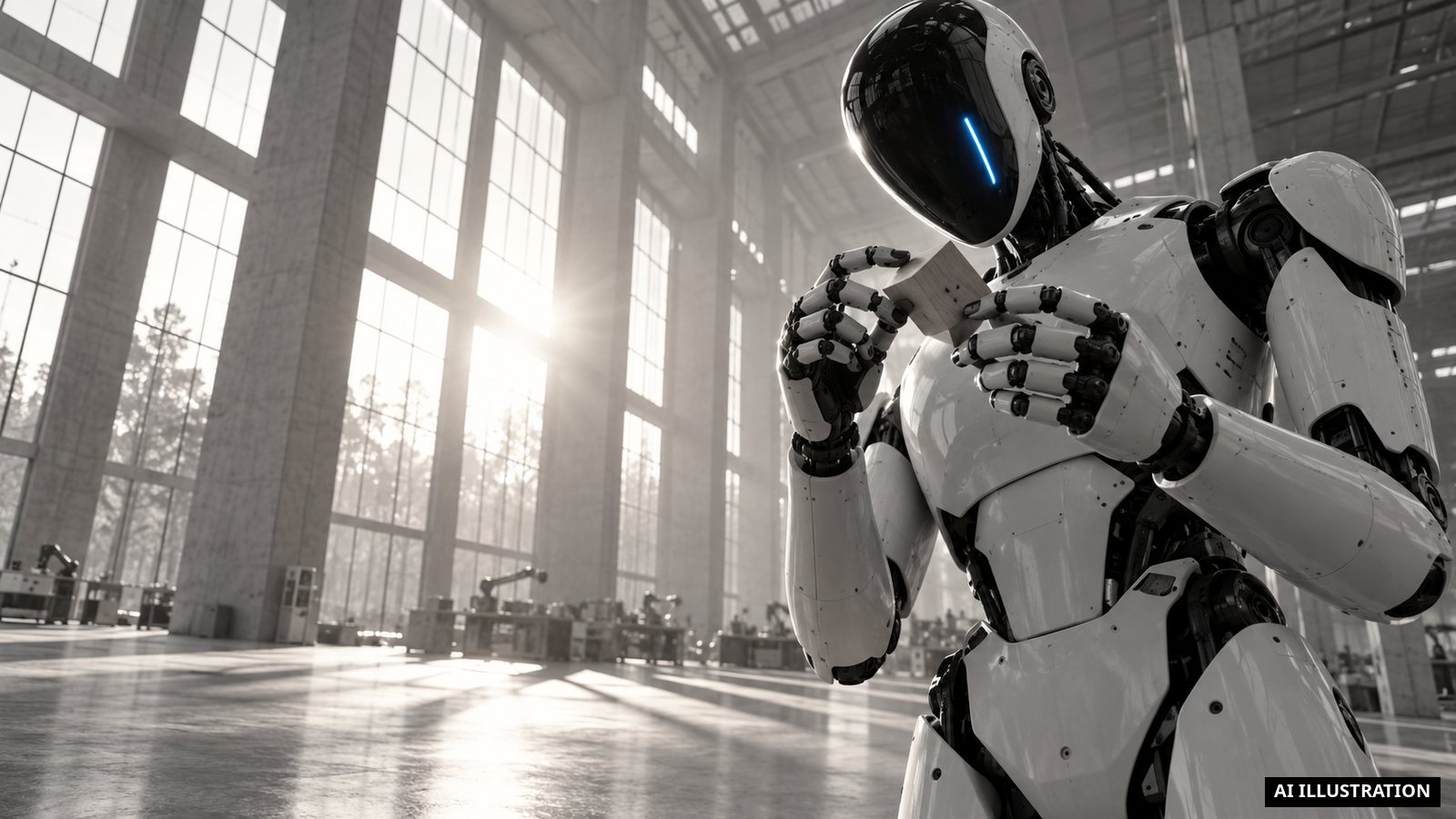
In Shijingshan, Beijing, the air is thick. One hundred humanoid robots move about in a school of more than 10,000 square metres. It is not a factory. It is a classroom. A data collection cluster there produces 29,000 hours of data a year (The Business Times). The machines are learning. Not to produce. To exist.
What a worker costs, what a robot costs
Look at your payslip. According to the Chinese research institute Guotai Securities, a human worker costs approximately 80,000 yuan a year (Corriere della sera). That is the price of your time, your fatigue, your mistakes.
But the robots are not there yet. The actual price of industrial humanoid robots generally ranges between 300,000 and 500,000 yuan (Corriere della sera). Morgan Stanley estimated the cost of a humanoid at approximately 200,000 dollars in 2024 and predicts 50,000 dollars in 2050 (Corriere della sera). The curve is descending. Slowly. But it is descending.
Unitree’s small G1 robot costs 13,500 dollars (Corriere della sera). That is the price of a used car. Humanoids intended for industry in China cost approximately 45,000 to 75,000 dollars (Corriere della sera). The difference is vast. And the latter still has to prove that it is worth its weight in metal.
The school that never sleeps
In Shijingshan, the data training centre for humanoid robots has been in operation since September 2025 (The Business Times). It is currently the largest robot school in China (The Business Times). Two hundred million yuan have already been invested in the first three phases (The Business Times).
Why so much money? Because arms are not enough. According to Interact Analysis, at least 90 data collection and training centres for humanoid robots were in operation, planned, or under construction in China at the end of April 2026 (The Business Times). The race is not about manufacturing. It is about learning. Every hour of data is a brick in the machine’s brain.
The Shijingshan centre currently has 100 humanoid robots (The Business Times). The collection cluster produces 29,000 hours of data a year (The Business Times). It is little. It is a lot. It is the beginning.
The hunger for data
Yao Maoqing says it without beating around the bush: embodied intelligence requires at least tens of millions of hours, and potentially hundreds of millions of hours, of data before its practical deployment (The Business Times). The total volume of high-quality real-world physical interaction data available globally currently amounts to only a few hundred thousand hours (The Business Times).
Millions of hours are missing. Millions. Robots have arms, legs, sensors. They do not have memory. No experience. No common sense. They must learn everything. Everything. From the simplest gesture to the most complex gaze. And every hour learned costs money. Electricity. Space. Time.
Perhaps tomorrow, the robot will no longer cost 500,000 yuan. Perhaps 160,000. Perhaps less. But as long as the Shijingshan school has not finished building, the robot will remain a student. And the student, for its part, does not yet replace the master. It observes. It learns. It waits.
And if the robot lacked above all data, rather than arms? And if your job, tomorrow, no longer depended on your salary, but on the speed at which a machine learns to resemble you?