On 13 December 2025, the Chinese manufacturer Unitree announced the launch of what it describes as the world’s first app store for humanoid robots, according to the specialist website Interesting Engineering. The image is easy to understand: much like the App Store on your phone, where you download games and apps, you could here equip your robot with new capabilities with a single click.
The formula is seductive, and that is probably why it was chosen. But when you look at what the platform — dubbed the Unitree Robotics Developer Platform (Unitree’s "developer platform") — actually does, the picture changes completely. It is not an app store. It is something else, and it is worth understanding what that is.
What is being highlighted: a dancing robot
To make the object appealing, the showcase insists on the spectacle. According to Interesting Engineering, the platform offers preloaded action routines: martial arts movements, a dance titled "The Twist", and even ballet sequences. Enough to make your humanoid move as if you were launching a video.
It is nice, it is shareable, and it occupies most of the conversation. The problem is that the dance is not the core of the product. It is the storefront.
First real function: you are the one piloting the robot
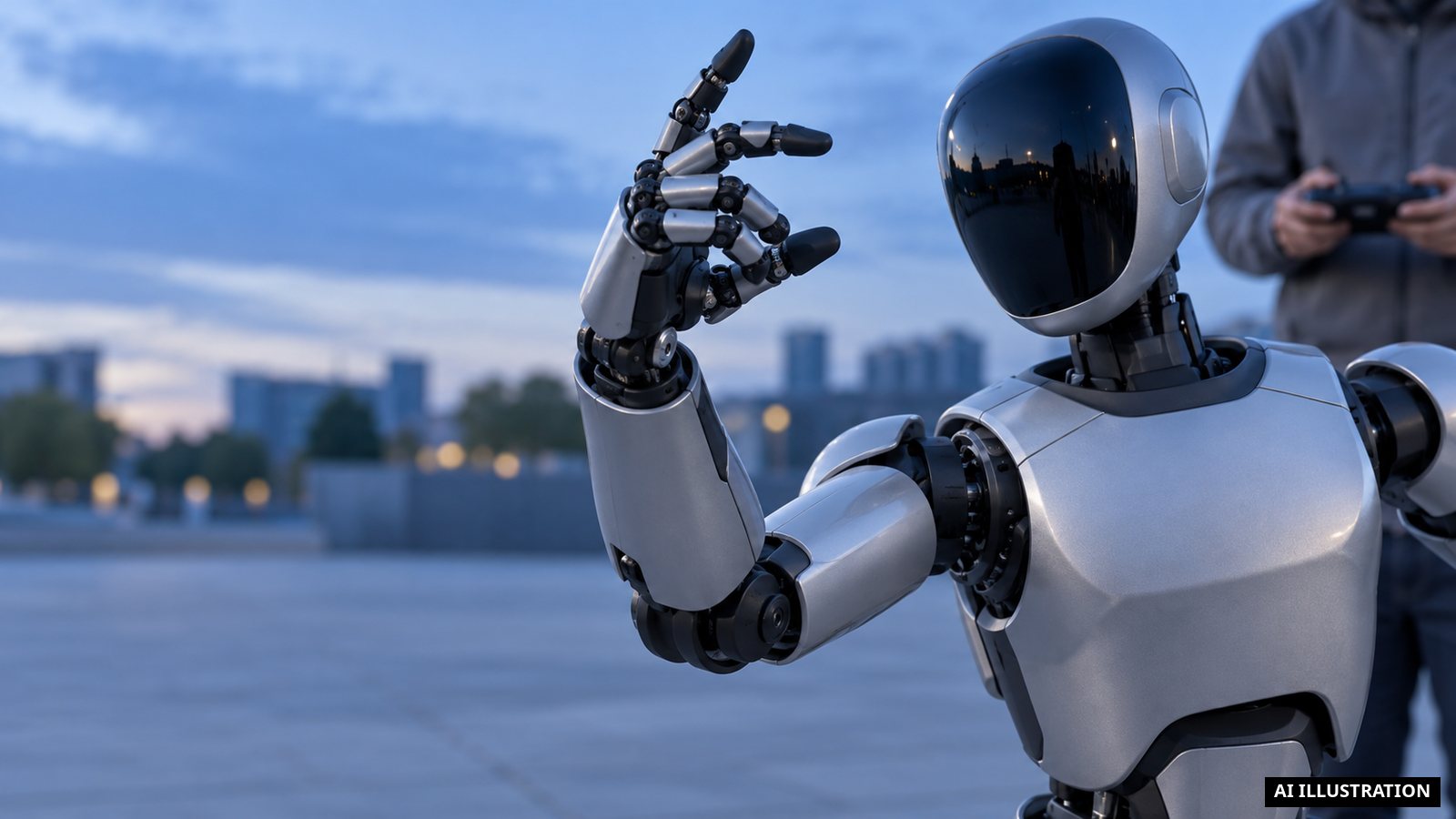
The first truly central capability of the platform is far less glamorous. According to the same source, the tool allows you to control the robot remotely from a smartphone, using the phone’s camera to guide its movements. In other words: you film, and the robot reproduces.
The technical term for this is teleoperation — a human piloting the machine remotely, in real time. This is not a minor detail. It means that, in many cases, it is not the robot that "decides" on its own what to do: it is a person, behind their screen, holding its hand at every gesture. The beautiful autonomy one imagines when watching a humanoid walk is, here, partly ensured by you.
This can be presented as a practical feature. It can also be read as an admission: if one needs a human and their phone’s camera to make the robot move correctly, it is because the machine does not yet know how to manage on its own.
Second real function: the data harvest
The second capability is even more telling. Still according to Interesting Engineering, the platform allows users to download, share and adapt training datasets — what is called in English datasets, that is to say large collections of examples used to teach something to an artificial intelligence.
Why is this crucial? Because it is exactly the fuel a robot needs to progress. Every time a user pilots their machine by hand, they produce, without necessarily thinking about it, examples of successful gestures: how to grasp an object, how to move, how to react. Put together, these human demonstrations become a valuable raw material for training future robots to do without… humans.
By linking the two functions, the picture becomes clearer. Teleoperation makes people work. The sharing of datasets harvests the fruit of that work. The "dance" and the "app store", for their part, attract people to the platform.
Why the label matters
Calling this an "app store" borrows from the reassuring world of the smartphone an image of entertainment and freedom of choice. But a classic app store sells you tools that you consume. Here, two of the highlighted functions consist mainly of making you produce something: your piloting, and the data that results from it.
This raises very concrete questions, which our editorial brief leaves open and which it is honest to pose rather than answer on behalf of Unitree: who exactly owns the datasets shared on the platform? What are they subsequently reused for? And is a service whose two main uses are to teleoperate and collect data really a product designed for the general public, or a machine for harvesting training material dressed up as a gadget?
It should be noted that this information currently comes from a single secondary source, the media outlet Interesting Engineering; it therefore deserves to be taken with the usual caution until Unitree has publicly detailed the workings of its platform. But the mechanics described are clear: behind the word "apps", there are mostly humans piloting, and data accumulating. The rest is just dance.