
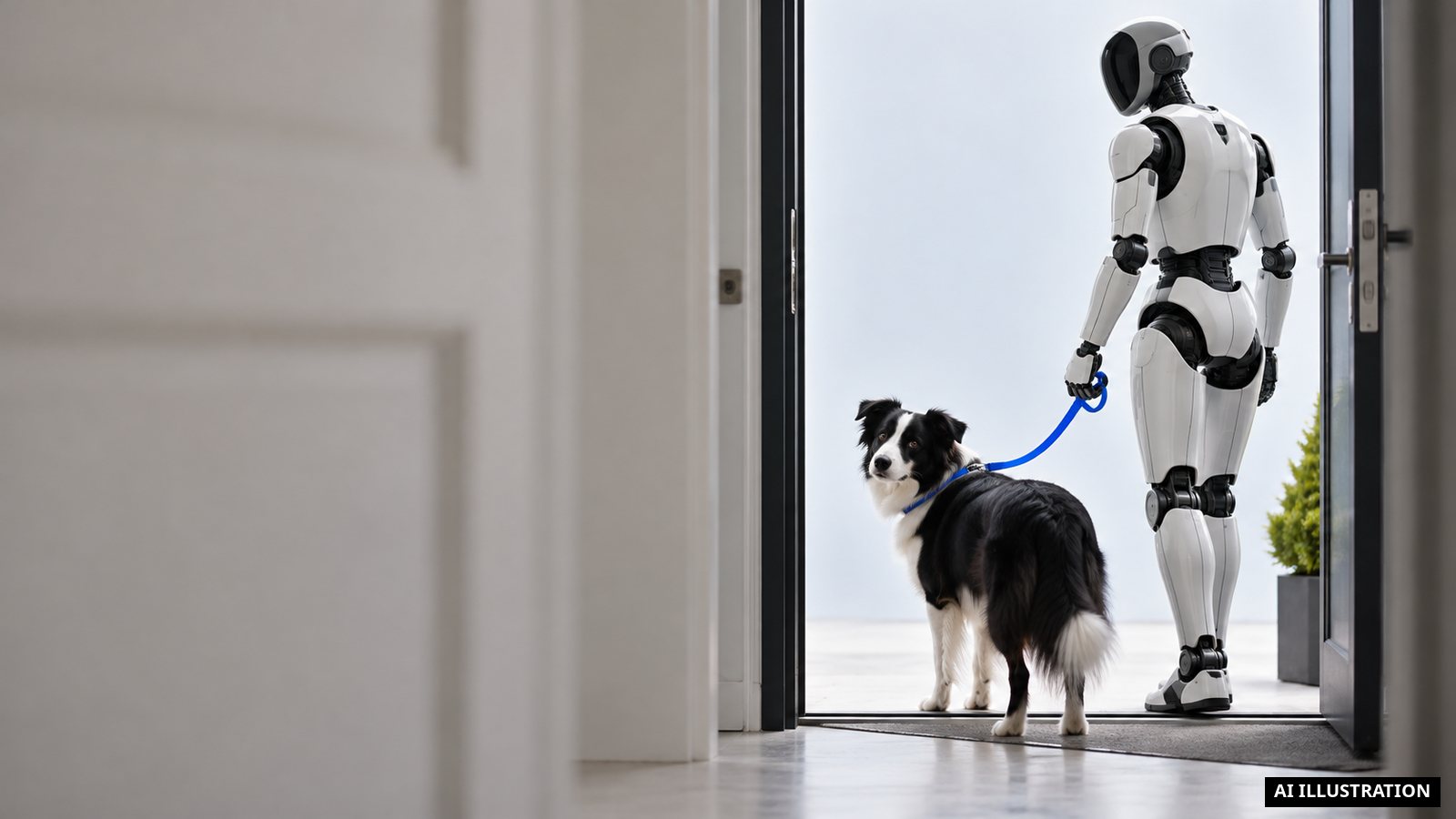
The park is quiet. The sun filters through the trees. A dog pulls on its lead. But it is not a man walking behind it. It is a metallic, rigid silhouette, moving in jerks. In Geneva, a humanoid robot was filmed walking a dog (Le Dauphiné libéré). The scene, filmed by a passer-by, has gone viral on social media. And it leaves no one indifferent.
We watch the video. We smile. The robot moves poorly. Its legs seem to hesitate. There is no grace in its steps. It is mechanical, raw. And it is precisely this that triggers a wave of massive online reactions, oscillating between amusement and scepticism (Le Dauphiné libéré). For many, it is funny. It is absurd. It is a technological joke that has gone wrong. But for others, the smile quickly fades. Because behind the gag, there is a question that weighs heavily.
The robot jerks, the dog may lead: who is walking whom?
The robot’s movements were jerky and lacked fluidity, which amused many netizens (Le Dauphiné libéré). We see the dog pulling, the robot stiffening, then moving forward with a hesitant step. The image is powerful. It reverses the roles. In our minds, the human is the master, the guide. The dog follows. Here, it is the opposite. Netizens have highlighted the irony of the situation by claiming that it was the dog walking the robot (Le Dauphiné libéré). It is an image that lingers. That of a helpless machine, pulled by a living creature, full of life and spontaneity.
This lack of fluidity is not a detail. It is a symptom of a technology that is still young. It executes. It reacts. It is there, physical, but empty. And it is this emptiness that intrigues. We wonder: what would happen if this same robot, with its jerky movements, had to manage something other than a walk?
Imagine your home. Imagine this robot entering your house. It crosses the living room. It passes by your child playing on the floor. Its steps are heavy. Its movements are unpredictable. It does not see the toy on the floor. It does not stop. It continues. And if, perhaps tomorrow, these machines were capable of doing more? Of carrying, pushing, moving things? The fear is not in the robot itself. It is in the lack of control. In the fact that we do not yet know how to master it perfectly.
« That’s scary »: the fear rising beneath the laughter
The experience has revived fears surrounding the rapid rise of robotics and a loss of human control in the face of the machine (Le Dauphiné libéré). It is the recurring theme of the comments. Beneath the memes and the laughter, a more serious voice rises. One user stated: « This does not make me laugh.... it is scary » (Le Dauphiné libéré). This sentence is short. It is dry. It sums up the discomfort of many. We stop laughing when we realise that the machine is there, in our vital space, and that it is not reliable.
Think of your elderly parents. Think of your tired partner. Think of yourself, in the evening, after a long day’s work. You need security. You need predictability. A robot that jerks, that hesitates, that can « blow a fuse » as another netizen puts it, is a source of stress. One user warned: « We will quickly stop laughing when all these things blow a fuse » (Le Dauphiné libéré). It is a latent threat. Not an immediate threat, perhaps. But a threat that grows with every new video, every prototype, every announcement.
The fear is not irrational. It is rooted in our history. We have always been afraid of what we do not understand. Of what surpasses us. Robotics is advancing quickly. Too quickly for our psyche to adapt. We want machines that are helpful, discreet, harmless. But we see machines that stumble, that freeze, that seem ready to topple over. And this image, that of the robot walking the dog, is the mirror of this anxiety. It shows us that we are no longer the only actors in our daily lives.
What if your dog’s walker was no longer a human?
Another user expressed concern about the end uses of these robots, stating: « What is worrying is what these robots will be used for, certainly not just to walk the dog » (Le Dauphiné libéré). This sentence is the key. The dog is a pretext. The walk is a test. But is the test harmless? No.
And if, tomorrow, this robot no longer walked the dog, but monitored your door? And if, instead of jerking, it moved with surgical precision? And if, instead of amusing you, it observed you? The boundary between service and intrusion is thin. We accept cameras. We accept voice assistants. But a physical body, in our garden, in our street, in our living room? It is a different step. It is a presence. And a presence that cannot be ignored.
The Geneva video is a mirror. It shows us where we stand. We are in a phase of transition. The technology is there, but it is fragile. It is noisy. It is visible. And we are divided. We want innovation. We want comfort. But we also want to remain masters of our lives. The question is not whether the robot will walk your dog. The question is: will you be ready to open the door to it?
The robot stops. The dog barks. The video ends. But the question remains. It turns in your head, in the evening, when you look out the window. And if the next step was not the robot moving forward, but you stepping back?