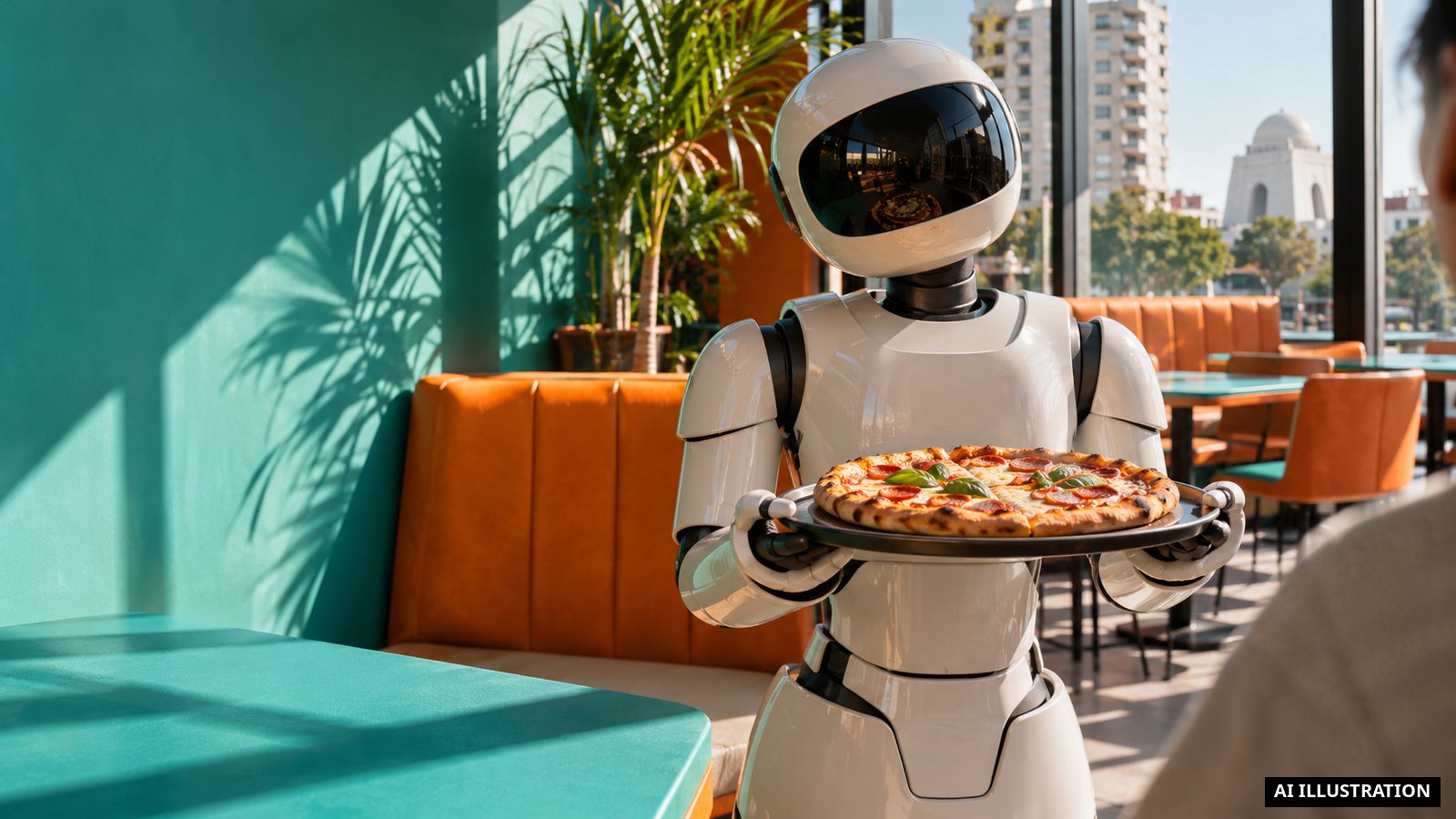
The door of The Sicilian restaurant opens. The hot air of Karachi seeps in, laden with the smell of the street and frying oil. But tonight, the attention is not on the table. It is on Robia. Spherical white head, dark visor, a black dupatta draped over the shoulders (Bourse Direct). She moves with a strange fluidity, too calm for a machine, too mechanical for a human. She places the tray. A pizza. The cheese is still flowing. (Bourse Direct)
You do not touch her. You do not speak to her. You watch. This is the first time this has happened here. Hellen, an employee of the restaurant, confirms it: it is the first time people have seen a robot in the region (BFM Business). Customers no longer come just to eat. They come to see. Some cross the entire city of Karachi, just to observe this duo of white silhouettes moving between the tables (BFM Business). Footfall has increased significantly, according to staff (BFM Business). The spectacle has become the main attraction. But behind this spectacle, there is a kitchen. And in that kitchen, there is a man who built it all.
The laboratory at the heart of the city
Syed Osama Aziz is not a chef. He is an engineer. He founded The Sicilian restaurant, but he also founded Cobot, his robotics company (BFM Business). He designed these two humanoids. Not by buying a kit. Not by following a plan. He designed the printed circuits. He programmed the robots. All of this in his own laboratory (BFM Business). This workshop is located in Multan, in the Punjab province, in the centre of Pakistan (BFM Business). Multan is not a high-tech city. It is a city of earth and tradition. And it is there that the servers of the future are born.
Manufacturing is a mix of local and imported. Syed Osama Aziz mainly uses locally made parts. The necessary equipment is difficult to find. One must search, negotiate, wait. Each robot is an assembly of constraints. No luxury. Necessity. And yet, the result is there. Ahmer Zameer, a customer, saw Robia approach him. She spoke. She gave the menu. No human voice, but a clear voice. A voice that does not tire. A voice that does not judge.
The tray you must take
There is a limit. A red line that technology does not yet cross. Robia brings the tray. She places it in front of you. But she does not serve you. Not yet. You must take the dish yourself. Or wait for the help of a human staff member (BFM Business). This is an essential nuance. The robot is a carrier. Not a server in the full sense. There is a missing gesture. The gesture of the hand that hands you the plate. The gesture of proximity. For now, it is you who take. It is you who break the silence. It is you who create the connection.
This restraint may be a precaution. Or a step. The robots are not autonomous in the sense that they would manage the entire social interaction. They are there to serve, yes. But they remain under supervision. Human staff is always present. It is the safety net. If the robot hesitates, if the customer asks for something complex, it is the human who intervenes. The robot is a tool. A very sophisticated, very visible, very impressive tool. But a tool. And tools, we use. We do not yet entrust our lives to them. Not quite.
What if she remembered you?
Imagine. You return to The Sicilian. You enter. The door opens. Robia is there. She sees you. Not just a face. She recognises you. She knows that you are Ahmer Zameer. She knows that you ate a margherita pizza last week. She knows that you do not like olives. She knows that you always have a soda. And what if, tomorrow, she no longer asked you what you wanted? What if she simply said: “Is your pizza coming?”
Syed Osama Aziz plans to add camera and image processing features. The objective is clear: to allow the robots to recognise customers and memorise their previous orders (Bourse Direct). This is no longer science fiction. It is a project. It is an evolution. The camera will not be a cold eye. It will be a memory. A memory that does not forget you. A memory that respects you. Because it knows what you love. Because it knows what you avoid. Because it knows who you are.
The American investment bank Morgan Stanley predicts that the world could have more than one billion humanoid robots by 2050 (BFM Business). One billion. This figure is immense. It is dizzying. But it is not abstract. It is there, in the dining room of The Sicilian. It is in Robia’s white head. It is in the printed circuit designed in Multan. One billion robots means one billion memories. One billion servers who know. One billion gazes that follow you. Not to monitor you. To serve you. To know you.
What if your waiter knew your name? What if your restaurant knew your habits? What if your home had a robot that knew when you came home, what you ate, what you avoided? The boundary between tool and friend becomes blurred. The boundary between service and knowledge becomes porous. You no longer eat alone. You eat with an entity that knows you. That waits for you. That recognises you.
The pizza is there. The cheese flows. Robia steps back. She waits. She does not yet speak to you. But she looks. And in her dark gaze, behind the visor, there is something that resembles attention. Not love. Not yet. But attention. And attention is the beginning of everything. It is the beginning of the relationship. It is the beginning of shared life. Even if, for now, it is you who take the dish. Even if, for now, it is you who break the silence. Tomorrow, perhaps, it will be her. Tomorrow, perhaps, she will know. And you, will you be ready?